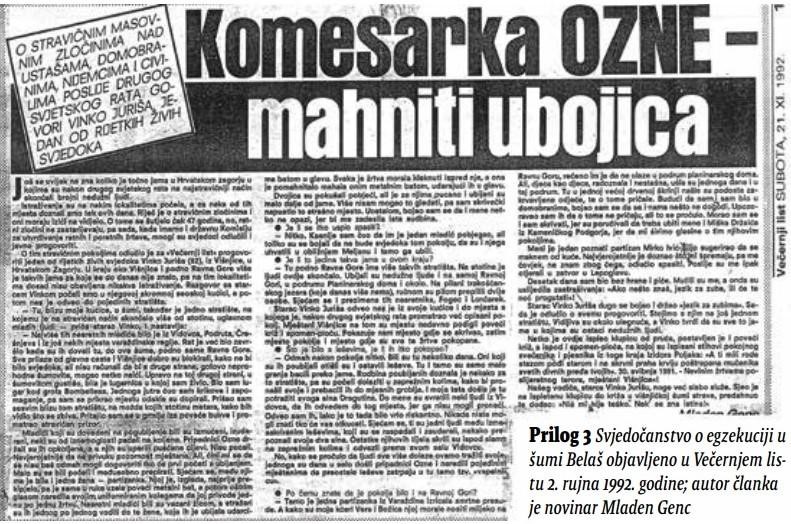





Croatian newspaper February 21, 2008.
Testimony about partisan crimes
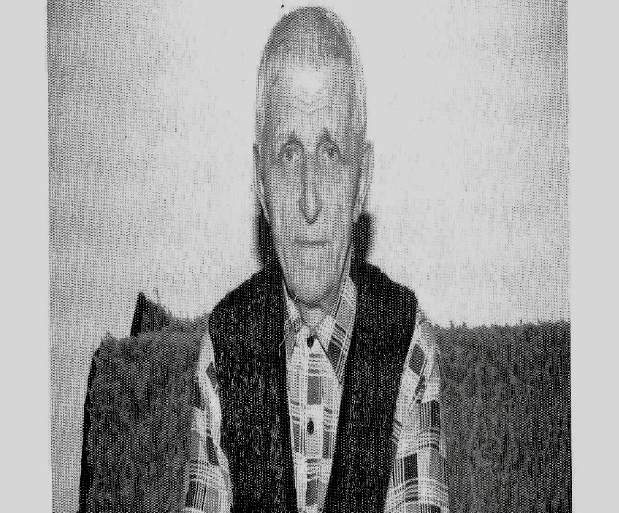
Hrvatski list once published a testimony about Partisan crimes, bringing the story of former Yugoslav National Army officer Marko Protić, who said, “I am not sorry that we killed the friars with shots in the back.” The officer who at the time lived in Zagreb, in the part called Voltino Naselje, admits that he was punished with a warning for killing Franciscan friars in Bugojno in 1944. He showed no remorse for the liquidations, however. During the interview, Protić asked angrily, “Why are you investigating this?” The interview with Protić was conducted by the Hrvatski List research team in 2008.
Accordingly, Protić, the murderer of the friars, did not become the subject of the investigation despite the evidence, although the mentioned weekly published not one, but two letters, one from a victim, and the other from him. These letters prove that the crime was committed. According to the letters, he shot two unarmed friars in the back in Bugojno in September 1944. He killed the pastor with the first bullet, while the other priest was seriously wounded and later saved. A letter from the surviving priest was also found, which not only describes the crime in detail, but also reveals how on another occasion the Partisans murdered patients in the beds of the department of surgery in Travnik in a heinous manner. The shooting of the friar by the Partisans was described in four pages in 1949 in Rijeka by the involved executioner, former JNA Captain Protić, emphasizing that he was performing party duties. This retired JNA officer with the rank of lieutenant colonel was employed in the National Defense Department in Trešnjevac until 1990 and is one of the few survivors of the victorious Partisan slaughters in Bugojno and Travnik. When he was punished with a party reprimand for not properly organizing the liquidation of two brothers, he wrote verbatim in his own handwriting:

“I was punished with a party reprimand on September 10, 1944 for the liquidation (murder) of two friars in Bugojno in 1944 during the liberation of the town. Me and my company commander Jovo Lončar were punished because we had not organized well enough the executions of the friars. The punishment had a proper effect on me, and I realized that as a party leader I had poorly organized the liquidation of these enemies of the people, who at the time still enjoyed certain sympathy among the religiously backward class of the people.”
The book “11. Dalmatinska brigada” (The 11th Dalmatian Brigade) by Milan Raka and Slavko Družijanić, published in Split in 1987, tells about a number of less known interesting facts about this Partisan unit.
There are two particularly interesting details about this unit:
- The selection of political cadres in the government from the ranks of the 11th Dalmatian Brigade, and the influence that extends to the present time.
- Numerous war crimes and massacres of women, children, priests and civilians in general, as well as disarmed and captured soldiers.
The list of members of this Partisan unit and its influence on later political life, both in Yugoslavia and in present-day Croatia, is also interesting and extremely extensive. Besides the mass murder of thousands of civilians and soldiers after the end of World War II in Kočevski Rog in Slovenia, the mass murder of priests and religious in the convent in Široki Brijeg is the most famous case blamed on this brigade and its soldiers.
At that time, hatred was sown in Široki Brijeg, a small town in Herzegovina, which still reminds us of the blood and ashes of that time. Franciscans were killed and burned, witnesses were killed or intimidated, but Široki did not remain empty and deserted. There is even an original recording of the conversation that Dr. Father Bonicije Rupčić and Dr. Father Rufin Šilić had with Sister Emerana Kozina on October 23, 1945 in Mostar to shed light on the murder of the Široki Brijeg friars.
Emerana (baptized Dragica) Kozina was born in Medjugorje in 1916. From September 1944 to February 8, 1945 she worked in Široki Brijeg as a cook in the convent kitchen. From her testimony the following needs to be pointed out:
“Sister! The Partisans tell everyone that the Franciscans in Široki Brijeg were shooting at them with machine guns. As an eyewitness, what do you say to this?”
“I can tell everyone and everywhere that no one was with me in the basement of the monastery, and everyone was there except for Father Dobroslav; excuse me, old Father Marko Barbarić was sick and lying in his room in the monastery. I do not think he could shoot if he could not even get out of bed. When he was well, he could barely hold a spoon in his hand.”
“Did the Franciscans know that the Partisans would occupy Široki Brijeg? If they knew, why didn’t they flee?”
“They certainly knew that the Partisans would come to Široki Brijeg, but they said, ‘We have no no guilt, so why would we run away?’”
“Sister, it is said that the Franciscans did confessions to each other and that in the evening they all received Holy Communion, having brought the Blessed Sacrament from the church. What do you know about it?”
“I know nothing of the communion, for I was already separated from them at 4 p.m. While I was with them, I saw some confess to each other, for example, Father Borislav and Father Žarko. Father Dobroslav also warned me, asking if I wanted to do the confession, but standing up, so that the guard would not notice. The priests did the same. Moreover, while we were still in the cellar, we all received general absolution. It was given to us by Father Stanko.” We should also not forget the bodies that were dug up in various mass graves.
Partisans from the island of Korčula, Ivan Gugić and Ivan Marinović, otherwise members of the 3rd Company of the 3rd Battalion of the 11th Dalmatian Brigade, spoke about the crimes of this brigade. One of the members of the 11th Dalmatian Brigade, Partisan Major Simo Dubajić, made a remorseful confession about the crimes of the 11th Dalmatian Brigade before his death. He is better remembered by the Croatian public as one of the leaders and organizers of the Chetnik insurgency in Dalmatia before and during the Homeland War.
Editorial/crimesofcommunism.net