




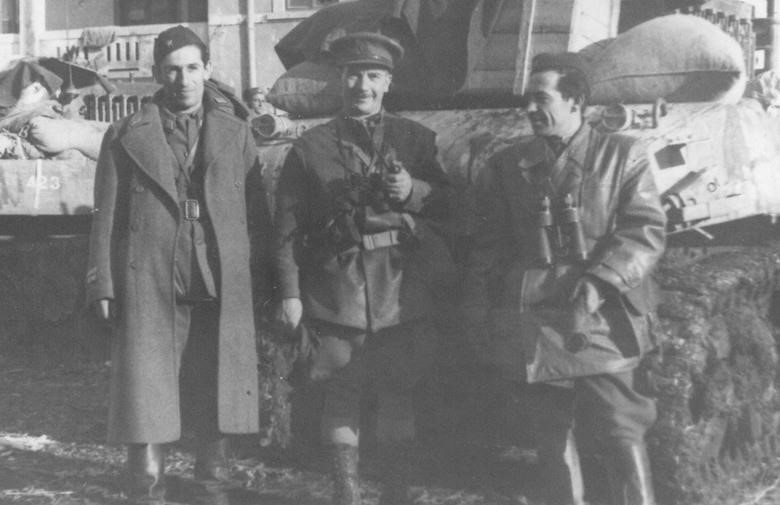
Partisan gunner T. B.: They killed a friar in front of my eyes
Široki Brijeg
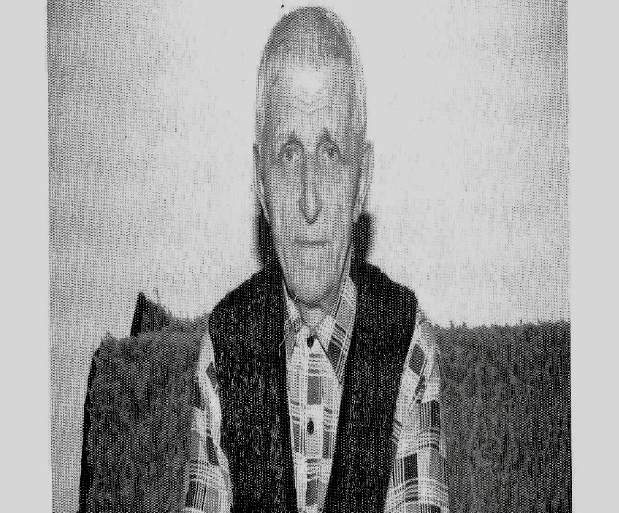
An interview was conducted in Omiš with former partisan gunner T. B. (born in 1925), who belonged to the 12th Dalmatian Partisan Brigade, the 26th Dalmatian Partisan Division, and is now spending his twilight years in retirement.
T. B. says, “First, when we entered Široki Brijeg, they gave us a free hand to do what we wanted, to do whatever our integrity allowed us to do. Second, they killed a Franciscan friar before my eyes, somewhere halfway from Široki to the stables on Gostuša, which I could hardly bear. Third, apart from the occasion of entering Široki Brijeg, we received exactly the same order when we entered Gospić, and there we had a free hand to do whatever we wanted, and as much of it as we wanted. And fourth, in Gospić we committed a terrible massacre, near the river Lika we shot dead, it is little to say a hundred prisoners, it was more like two hundred, and that hit me even harder.”
A few days ago, in Omiš, I spoke with former Partisan gunner T. B. (born in 1925), a member of the 12th Dalmatian Partisan Brigade, 26th Dalmatian Partisan Division, who is living his old days. Since the Partisan gunner T. B. was willing to share with me his memories of the fateful February 1945, when Široki Brijeg was forever plunged into mourning, and since this part of his story particularly interested me for understandable reasons, we met in his home in Kaštela as agreed. Although the focus of our conversation was on the events of the fateful year 1945 in Široki Brijeg, we naturally did not limit ourselves to this part, but also talked about the events after the fall of Široki, in which T. B. was involved. From October 1944 to May 1945, T. B. was part of the Partisan army as a gunner, and he says about that time: “It was more than enough to completely change my life, because of what I saw and experienced.” From the long conversation, I have selected only those parts that I believe will be of special interest to the public. As he himself said, T. B. simply and without much thought rejected all the privileges offered to him as a member of the victorious army after the war, such as an apartment, a job, etc., justifying this by saying: “We were poor victors! When I saw what we did to people, my whole world turned upside down.” In his life, a long time ago, right after the end of World War II, the spiritual life began to take the place of the material one, which was clearly evident in his behavior and in his entire life.
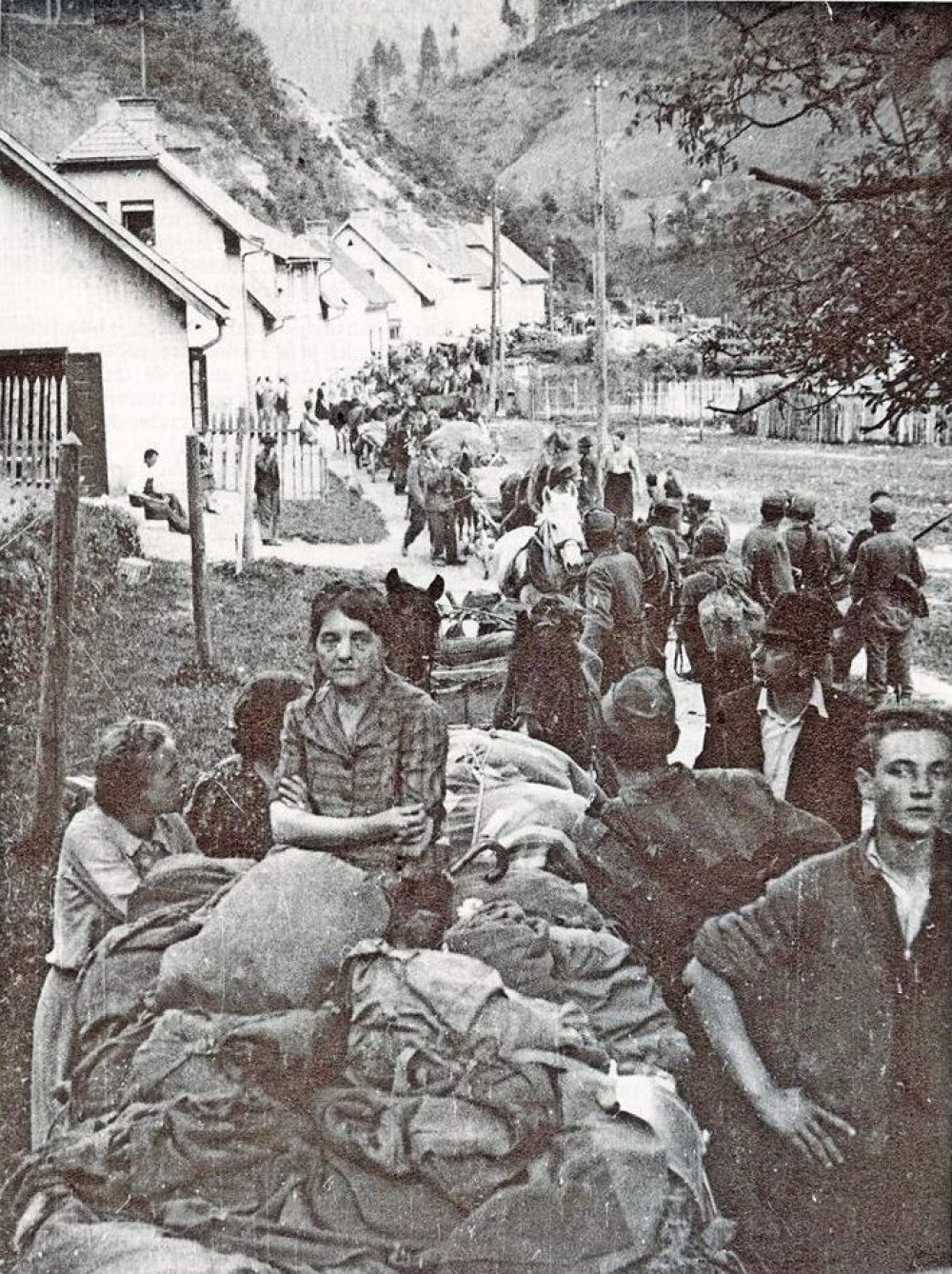
“And when Split fell, there was nowhere to go. Done! Mobilization happens by itself, no one asks you anything, you just go! When they came, they took everyone with them, we all left! And Split fell on October 20, 1944. In that situation, you go of your own accord, no one needs to specially mobilize you. Shortly after Split fell, maybe two or three days later, I felt I should go. I tell you, there was no special mobilization, but just like that, it happens by itself. You just go! They put me in the 12th Brigade, 26th Division,” says the old man T. B. and continues to describe in detail the wartime journey of his unit. “Our route was, of course, mainly on foot, first to Drniš, then to Knin, then to Sinj, then to Imotski, then to Široki Brig, then to Mostar, then on foot to Podgora, then to Biograd na Moru, from there to Lika, then the first attack on Lapac, then to Bihać, then from there back to Udbina, then to Gospić, then to Senj, then to Sušak, then to Istra, then to a part of Slovenia, and that’s where the fall hit us, in Monfalcone, that is Tržić.”
He explains that there were no major skirmishes until they reached Široki Brijeg, and then he says, “When we reached Široki, it was February of 1945. We had a free hand there, you know, like that saying, ‘You have a free hand.’ I arrived in Široki Brijeg, maybe one hour after the fall of the town; everything was over when we arrived. The army had already left, the combat had calmed down, and we were told, ‘You have a free hand, do what you want.’ Which meant, ‘kill, burn, steal, do whatever you want.’ I cannot say who gave that order, but it suddenly spread throughout the army. So do what you want, as much as your integrity allows. Integrity, character, conscience, who had that… Nobody asks you what you want to do, what you do not want to do; you decide for yourself… And who gave the order? My brother, the question is who!? I forgot the names of the commanders, I only remember that my commander was from the island of Vis. I was nineteen years old, like I knew anything or thought about anything. I just wanted to find something to eat. And that was the first and most important thing for me. And the platoon leader was a Montenegrin, he had a low rank, it seems to me he was an ensign. Later they killed him when he forgot the barrel of the mortar… One often felt depressed and did not care about anything, not even one’s own life. Tired, unhappy, hungry, feeling bad, you know… In Široki Brijeg itself, I didn’t see much. When we arrived, everything was already over. Only smoke could be seen, fires were burning here and there. We did not go up the mountain to the church in Široki Brijeg, we went further, to Mostar.”
However, the road did not lead them directly to Mostar, but via a detour, because it went over the hills above Široki, where the German army was still firmly defending the retreat with its troops in this area. On the way from Široki Brijeg to Gornji Gradac and Gostuša, T. B. described the execution of a Franciscan priest that took place in front of his very eyes: “The priest was traveling with us and suddenly… Well, was it a simulation, or the man really could not continue, who knows… And the priest fell down. Like, he couldn’t go on… One of the soldiers lifted him up and the other two supported him. They let him go and he stopped again. And they asked him, ‘Do you want to go?’ The friar said, ‘I cannot!’ They asked again, ‘Do you want to go?’ He said again, ‘I cannot!’ And the soldier took out his gun and killed him before my very eyes. That’s what I saw… It was in the middle of nowhere, there was nothing to see. There are barns up there, it’s a narrow path, no one is there, and down there is Široki Brijeg. I have the impression that it happened a bit closer to Široki Brijeg than to the top of the hill and the barns. At least that’s how it seems to me. And we, like always, just kept going… I cannot remember anything about friar’s appearance, it happened a long time ago. I only know that he wore a Franciscan uniform. No one even paid attention to any details, no one was allowed to look too much anyway.”
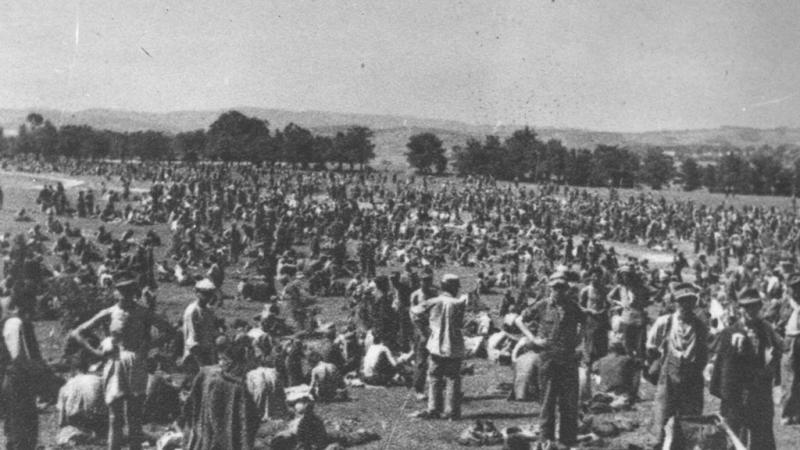
They stayed in Gostuša for three or four days. Extremely high snow fell. They ate only sauerkraut, that’s all there was, because their supply unit got ambushed somewhere and they all perished. Then they continued from Gostuša to Mostar, where they finally got their hands on bread, German brown bread in unlimited quantities. Then they continued along the coast and islands, first to Lika and then across Istria to Slovenia. In his narrative, T. B. highlights Gospić, saying, “When we arrived in Gospić, we were given a free hand for the second time. Široki Brijeg and Gospić are the only two places where my unit had a free hand to do whatever it wanted. Do whatever comes to your mind as far as your integrity and character allow for it. And everyone knows what happens when a man is left to his own devices… After that, I immediately changed my mind. Whoever was inclined to humanity, moreover, whoever was at least a little bit human, and if he or she was a tad bit inclined to civilization and Catholicism, he or she had to change when they saw and experienced something like that… In fact, in Gospić I saw even less than I had seen when that friar was killed. That in Gospić, that was too much, God forbid. And ours were, like, just taking revenge. In Gospić there is a river, the Lika. We lined up many prisoners along that river Lika. It is little to say there were one hundred of them, there were more like two hundred. But no one even counted… And suddenly they start mowing down. Our guys were mowing them down and they were just falling, falling into the river. Almighty God, this crime, this tragedy! And a prisoner escaped from this clench and ran to the river. They were shooting and shooting, in vain.
Away he ran! He crossed the river and was not hit, or at least he was not wounded heavily. But then a tank came and ran him over… In Široki Brijeg I was shocked that a friar was killed, but after what I saw in Gospić, I was not the same man that I used to be.”
In our conversation, the Partisan gunner again felt the need to return to the beginning and the events in Široki Brijeg: “But let us be clear: in Široki Brijeg, when they killed the friars, even if someone had seen it, they were not allowed to say anything. If you talked, you would remember that moment because you would pay for it dearly. I know that only we could have committed that massacre in Široki Brijeg, no one else could have done it. But to talk about it and who did what, and how they did it, well, that wasn’t allowed at all. Not even among ourselves. It was not talked about. You kept your mouth shut if you wanted to save your neck and stay alive… And we were constantly told that the priests of Široki Brijeg were this and that, that the nuns were the same way, and that they all paid for what they deserved only. The same thing was repeated over and over again, against the priests and the nuns… And then the commander came and said, ‘Boys, you have a free hand, do what you want!’ And it is known who they received orders from. It always came from the above! And then what will the army do if you leave them to their own devices…? The whole thing in its entirety was god-awful!”
Although he could not remember who had given the order for a free hand, at the end of the conversation my interlocutor still said inadvertently, ‘… and then the commander comes and says that we have a free hand…’ I do not hold a grudge! But all secrets come to light eventually…
AUTHOR:
Marko Knezović/vecernji.ba
Our comment for the record:
The commander of the 26th Division from 1943 to 1945, Božo Božović; the political commissar Vojin Popović, the commander of the 12th Dalmatian (islandy) Brigade, Josip Bepo Martinović (replaced by Đorđe Nikitović on March 13, 1944), political commissars Fabijan Trgo and Kažimir Vidan; deputy commander Roko Negodić (replaced on March 13, 1944 by Pero Vukasović); intelligence officers Andrija Kuljiš and Luka Vučković. This brigade and the entire division were mainly involved in clashes with NDH units in the area of southern Croatia and Herzegovina. Various crimes are associated with it, from Dalmatia in 1944 to Bleiburg, where it was involved in mass liquidations of both captured soldiers and civilians.
Editorial/crimesofcommunism.net