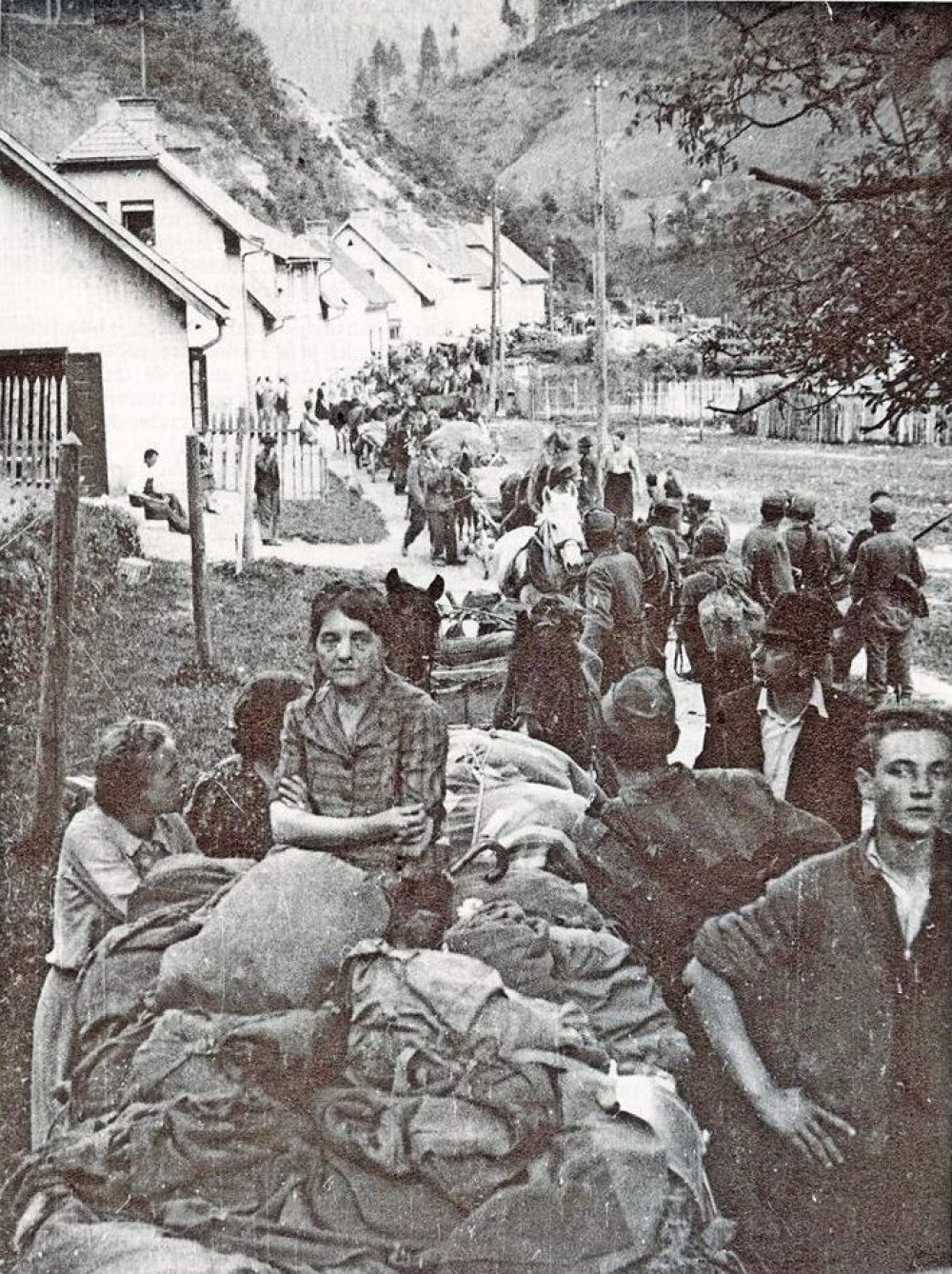





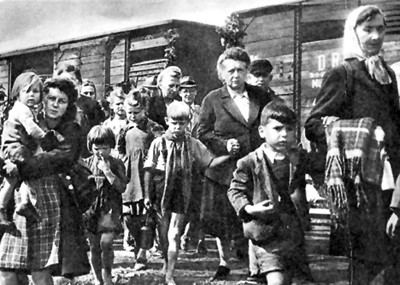
On Christmas 1944, all men between the ages of 18 and 45, and all women between the ages of 18 and 30, and later up to the age of 35, were deported.They were evicted from their homes and sent away by train in cattle cars.
Germans from Podunavlje
The Podunavlje Germans lived for centuries like islands in the sea, in German ethnic communities, surrounded by other peoples. Although far from their motherland, they firmly preserved their own identity, customs and language. For centuries, they remained unscathed by political events in places of their roots. Their language was their only identity.
Forcibly expelled
Everything changed when the winds of World War II swept over them, and in a few days they lost everything they had created for generations. After fleeing their birthplace, they were much poorer than their ancestors when they arrived there 250 years before. They were left with nothing and once again they had to start all over. Those who managed to escape before the Red Army invaded the Danube countries were lucky.
They encountered no hostility either in Austria or devastated Germany but no one believed their stories of the wealth they left behind. But of all the hardships and genocides experienced by the Germans, the most cruel and terrible tragedy is the fate of children lost in communist Yugoslavia. Today we know that between 40,000 and 45,000 German children under the age of 14 were sent to Tito’s camps, and at least 6,000 (13 percent) starved to death. The brutal abduction of children from their mothers was particularly cruel, as almost all young women were sent to Russia as slaves.
It is also documented that more than 20,000 children were taken from these camps and sent to orphanages throughout Yugoslavia. Siblings were separated, most of the children were given Slavic names and sent to areas far from the homes of their ancestors, to be introduced to a new ideology that would make them true patriots of Tito’s state. This process of renationalization runs counter to the 1948 UN Declaration on human rights and personal dignity. It is our duty not to forget them. As the war took hold, the Croats advised the ethnic Germans to leave while they still could. In Slavonia and Srijem, the inhabitants were more immediately exposed to war, so most fled to the west. Those accustomed to various natural disasters, such as famine, loss of harvest, floods and earthquakes of various kinds, decided to stay, hoping for better times to come. Of course, they assumed that political changes would end after the war, and they would continue to live as centuries before under the motto of loyalty to their ethnicity and the state. As the Soviets occupied the Pannonian Basin, home to more than half a million ethnic Germans, they left the fate of the locals to the partisans. These partisans were not members of a disciplined army, but a brutal group of bandits from Bosnian and Serbian mountains, who appropriated the property of ethnic Germans as spoils of war. Were these partisans afraid of resistance? Of course not! Everyone was on the front, only women, children and the elderly remained at home, and had no means to resist.
On November 21st 1944, Tito’s administration in Belgrade announced the following:
- All ethnic Germans living in Yugoslavia shall lose their citizenship and citizens’ rights.
- All property of ethnic Germans shall be confiscated by the state.
Based on that, 200,000 Germans in Podunavlje remained outside the law. The Soviet leadership insisted that the Yugoslav government pay for their occupation of Podunavlje, or, as they said, the price of a “free Yugoslavia”. Belgrade was bankrupt and could not meet those demands. Still, the Soviets persevered. If Belgrade could not pay in gold, it could pay in kind, i.e. in workers that were desperately needed in war-torn Soviet Union. Paying with workers? It was easy then! All the Germans were outlaws; they could take whoever they wanted. So, they talked about ‘work commitment’ (Arbeitsverpflichtungen), and went to German villages to round up workers.
About 2,400 women were deported to the Soviet Union from the Banat town of Apatin alone, and, not counting women from Bačka, Slavonia, Srijem and Bosnia, in total more than 40,000 women from Banat were deported. On Christmas 1944, all men between the ages of 18 and 45, and all women between the ages of 18 and 30, and later up to the age of 35, were deported. They were evicted from their homes and sent away by train, in cattle cars. They traveled for 17 days during the Russian winter to the mines in Kryvyi Rih and Stalin. In most cases, their children were left alone. What kind of nightmares did those mothers have, worried about their children? What kind of nightmares did they have, deep in the mines where they couldn’t hear from their families? Only one in three women returned home. Home? There was no home. They were sent to East Germany, broken and desperate. A new difficult ordeal (Leidensweg) began there: the search for their husbands, children and relatives. It was un unspeakable horror for children who were separated from their mothers. That wound cannot be healed for a lifetime. The lives of young children were a little better if they had older siblings to take care of them. The kindness of neighbors eased the pain in homes where children were left alone. Dependent on each other, the Germans had developed mutual solidarity over the two and a half centuries of living among other nations. But now the partisans were masters, and no one was safe from their crimes.
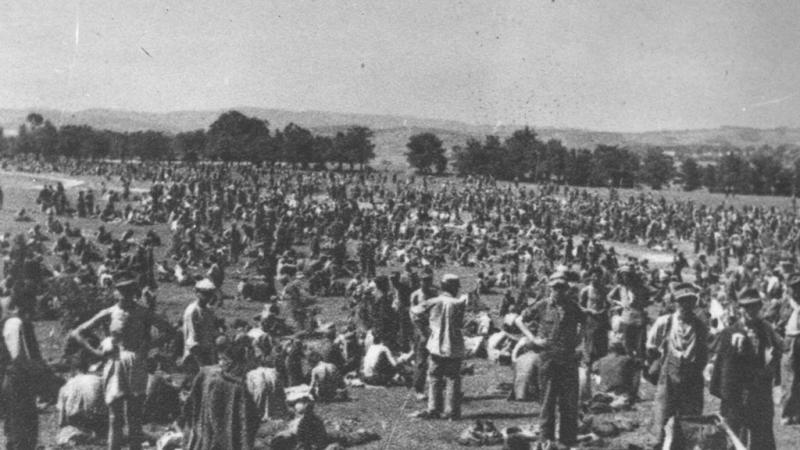
They gathered all the Germans who remained there, including children and the elderly, and put them in camps. Those who were able to work were sent to labor camps, while others ended up in Tito’s most notorious death camps, such as Rudolfsgnad (Knićanin) and Gakovo.
AVNOJ (Anti-Fascist Council of the People’s Liberation of Yugoslavia) planned to eliminate every single German from Yugoslavia within three years (until 1947). According to statistics, by 1948, when most of the camps were closed, only a few tens of thousands of the 200,000 German detainees remained alive. The White Death, as famine was called, was an easy way for Tito’s administration to get rid of the Germans. Every day, a hole the size of a living room was dug and the dead were thrown into it. The Belgrade system worked perfectly for them. The youngest children were the first to die.
Father Wendelin Gruber from Filipovo (Bačka) spent some time as a prisoner in the Gakovo death camp. He visited the childrens’ barracks in the camp. In each room, about twenty children lay on the straw, poorly sheltered from cold, skin and bones, sick and with infected wounds. No one cared for them. The survivors talked about an old man from Filipovo, a grandfather, who had gathered all his grandchildren. As many as 28 of them ended up in the death camp. (“Erased Peoples” – L. Rohrbacher). Another old man describes the situation of abandoned children: “The children were sitting and crying, and if someone threw them a watermelon to eat, they would be happy for the rest of the day.” By 1947, rumors of the camps had reached America, and Tito’s administration was finally forced to do something. They sought a “humane” way of dealing with children, and decided that it would be wiser to indoctrinate them with their own communist ideology. Toddlers aged three and younger would not remember the names of their parents or where they came from, so they sent them to orphanages where they were raised to have an aversion to everything German.
One of the children, Katharina Sesko, married to Mandel from Sekitsch (Lovćenac), wrote in her diary: “In the summer, carriages passed through the Gakovo camp and gathered all the children who no longer had relatives. We were taken to a house in Gakovo, where other children were already waiting. A little later we were all taken to Stara Kanjiža. About 400 children from different camps were gathered there. In Kanjiža we got some bread and milk, our first meal after such a long time. Our eyes practically popped out of our heads when we saw the bread. We were all very malnourished and starving, and a few of us were sick. We finally received medical care and had enough food. After we recovered, we were placed in various orphanages with Serbian children, only a few ethnic Germans per orphanage, in order to learn Serbian. I was in an orphanage in Sombor.” In an open letter of January 1950, Salzburger Nachrichten (Salzburg News) reported on the tragedy of 45,000 German children and their parents in Yugoslavia, but Eleanor Roosevelt, who was in charge of human rights at the UN, did not respond. In 1950, Professor Adalbert Gauss from Bačka described more than 40 orphanages in the book “Kinder im Schatten” (“Children in the Shadows”). In his book, he argued that the children were raised on the ideology that the state is their mother and father, and that they owe it absolute obedience.
Source:
Mojahrvatska.vecernji.hr
Editorial board/crimesofcommunism.net