




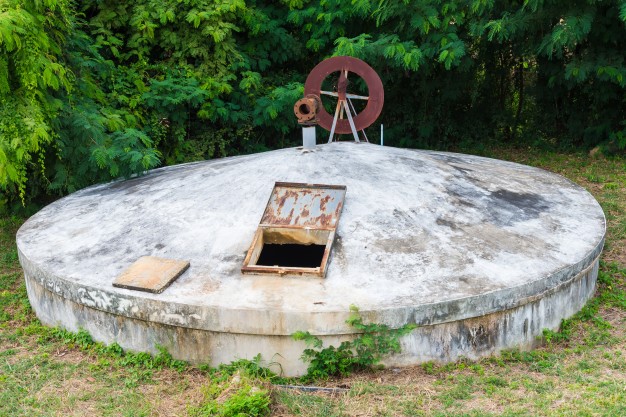
The image of the water tank is symbolic
Bežigrad – Celje
Testimony of a Slovenian refugee about the massacre of 10 thousand prisoners near Celje.
The young K. L. V., born on June 16th, 1936 in Celje, made the following statement before this committee in Rome:
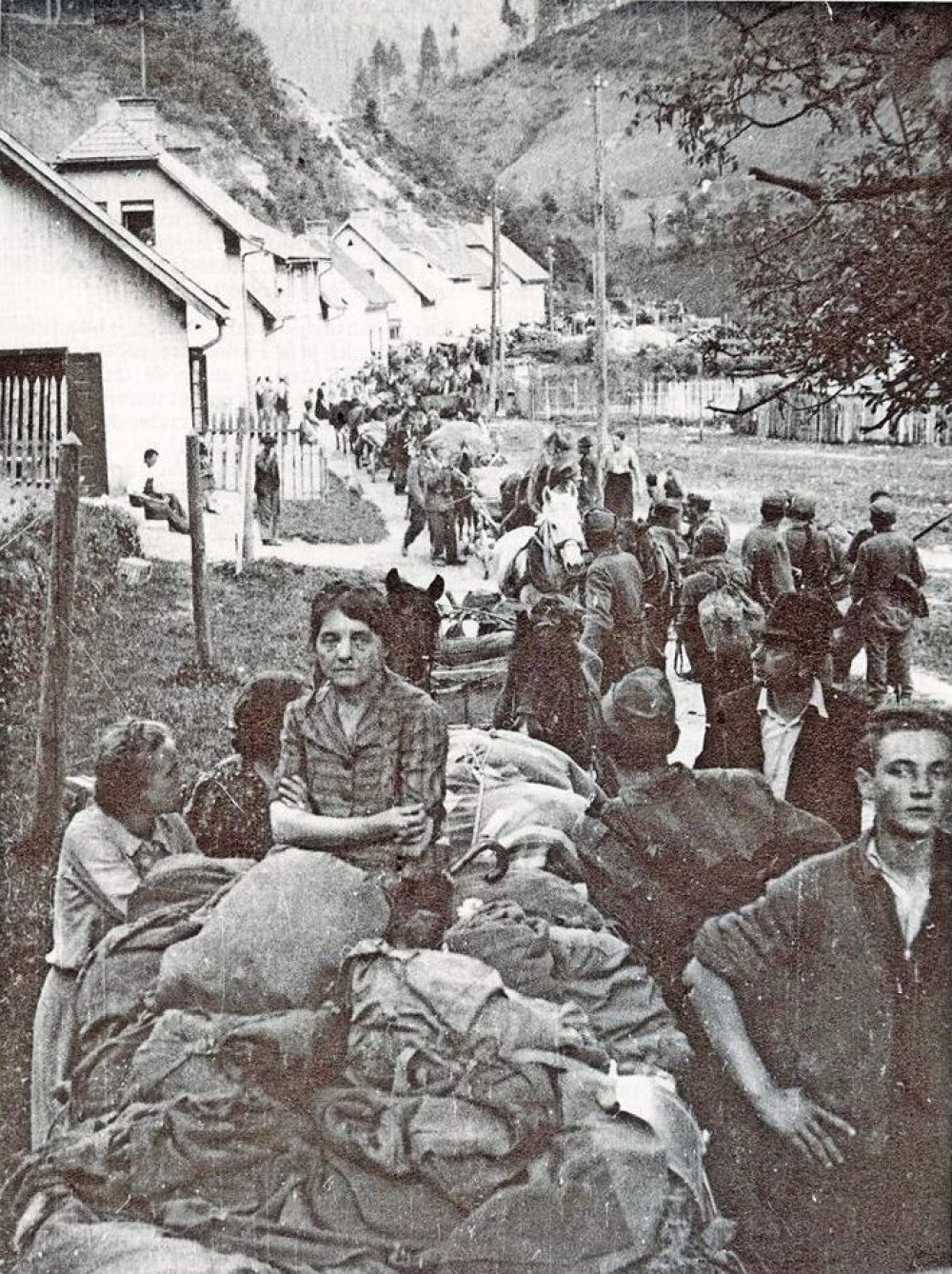
When Germany capitulated, on May 9th, 1945, several retreating armies passed through Celje: Germans, Croats (more numerous than others), as well as Slovenian home guards, coming from three directions: Zidani Most, Rogaška Slatina and Maribor- Št. Juraj. Most of them marched off in the direction of Vojnik-Dobrna-Slovenj Gradec and Žalec-Slovenj Gradec.
Many soldiers were captured and later brought in from all over. From my house I saw numerous columns of prisoners in most miserable of conditions, tattered, hungry, and exhausted. On the road lay the dead and slain; those who could not continue their journey or wanted a drink of water were killed by the guards. The partisan commander was a man by the name of Palček, a native of the village of Dramlje, whose headquarters were in the village of Zgornje Slemene near Dramlje. New partisans arrived, and I especially remember one Bosnian brigade because its chief was appointed commander of Celje, and he didn’t even know how to sign his name. Instead, he would just scribble some sort of line.
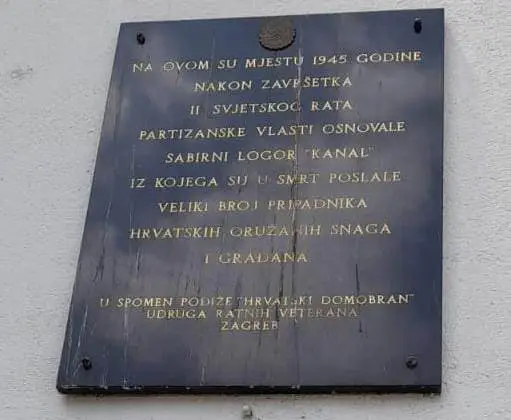
The prisoners were usually taken to the Bežigrad concentration camp near Sv. Ana, five kilometers northeast of Celje. The partisans fenced the camp off with barbed wire so escape was almost impossible. The camp was located on the hillside between Bežigrad and Sv. Ana, about a kilometer and a half from both locations, along the road Bežigrad-Blagojna. I visited this camp several times after the partisans left, and counted eight barracks; each was about 30 meters long. In the middle was a concrete cistern, which rose about 40 centimeters from the ground. Four steps led up to it from two sides. It had a solid door. The office of the camp command was in one of the barracks.
The first prisoners were brought there on May 10th or 11th, 1945, a few days after the end of the war. The massacre began immediately, perhaps on the very first day. The commander of the camp was Franc Sotošek, between 28 and 30 years of age, the son of a tailor from Blanca near Rajhenburg. He later became the head of the UDBA in Ljubljana and Celje, and then the head of the Začret peasant workers’ cooperative, but was sentenced to 18 months in prison for embezzlement and fraud. I know him personally: he is tall, burly, missing an eye. His deputy was Anton Sume, a native of Ljubečna. Among the other criminal police officers who committed massacres were N. Benešek, a native of the municipality of Dobje (with the communist nickname “Luka”), Štefan Krušč, also from Dobje, and Ruden, an official at the Ulmann factory.
The prisoners were killed in various ways. They would squeeze between 100 and 200 people in the tank, who had to stand hunched over because the tank was very low. Then they would slowly fill the tank with water until everyone drowned. Other prisoners would retrieve their bodies and bury them along with those who were shot. Before being shot, they were stripped almost naked, and taken to a valley along the Bežigrad-Blagojna road, below and around the camp in the direction of Sv. Ana. The prisoners had to dig their own graves before being mass-executed with automatic weapons. The dead or half-dead were buried quite shallowly, because there was not enough earth there, and the executioners were in a great rush. I am not aware of any other method of killing, but I do know there was some sort of torture mechanism in the camp and that some victims died there under torture.
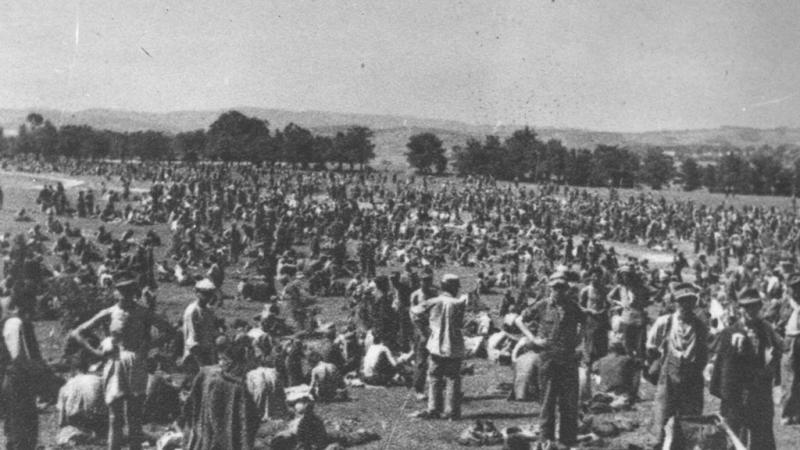
The camp was full, and many prisoners lived tightly squeezed outside the camp itself; I reckon there could have been between 2 and 5 thousand people there. Those killed were quickly replaced by new candidates for death. The main victims were Croatian and Slovenian home guards, a number of Germans and, finally, civilians, including a significant number of women. I do not know the number of those killed, but it is estimated that there were more than 10,000, mostly Croats. These massacres that took place day and night were not a secret among the inhabitants of Celje and surrounding area, especially Ljubečna, Blagojna, Sv. Ana, Zasret and other nearby places. Those who photographed the slain victims were even sentenced to 15 years in prison. The Yugoslav Communist Army left the camp in March 1946. At that time, I was still roaming around the camp and the site of the massacre, because access to the camp itself was very restricted. These massacres took place in May and June, and their intensity subsided by September 1945. After March 1946, I was in the camp and at the site of the massacres, retrieving ammunition. Today they usually perform maneuvers and military exercises there. Sites of massacres and graves are in that valley. There are ten mass graves, each 250 meters long and 180 meters wide. They run parallel to one another and occupy part of the said valley. The stench remains even today, and the terrain is impassable, because it is unstable and unsafe, and one’s feet sink into the ground. I saw heads with hair, arms and legs protruding from these graves, and I also saw dogs scattering the bones of the victims who were shot.
I also saw mass graves along the Austrian border, more precisely – 4 kilometers from Prevalje, at the Prevalje-Mežica intersection, near the Peasant workers’ cooperative “Kraljevo”, and not far from the house of the peasant Vodep. There is a half-ruined church nearby. There are fewer graves than in Bežigrad, and I think that some 2,000 people, who were slaughtered by a Bosnian brigade, were buried there. According to the villagers, the last person to die was the commander of that unit of Croatian soldiers.
A for what I stated above, and partly seen with my own eyes, I am ready to swear and testify under the threat of any kind of sanction. What happened in the camp was told to me by my uncle, who had been there for four months and witnessed horrific scenes. My uncle now lives in his house.
This testimony was read out to me, and I confirm that it is true and accurate
Rome, July 21st, 1954
K.L.V., in his own hand
I would like to add that a 15 cm thick file on this matter exists in the Directorate of the Communist Police in Celje (UDBA), housed in the former Ravnikar building, near the polyclinic, in the Agitprop department, register 4, shelf on the left, section 2. I had it in my hands.
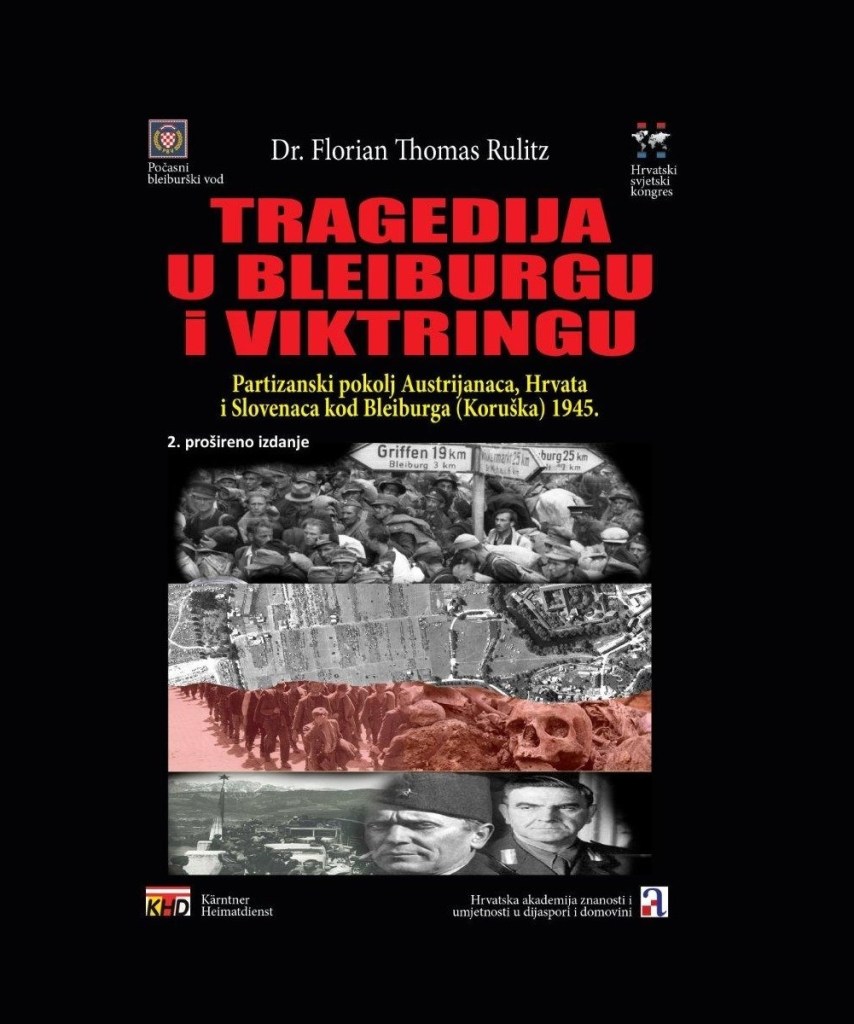
Important note: Due to this testimony, as well as others found in the book “The Bleiburg Tragedy of the Croatian People”, Barcelona, 1976, in 1971 UDBA executed Ivo Bogdan, who published the book in Spanish, long before this 1976 Croatian version. More about it in the article!
Source:
Vinko Nikolić, The Bleiburg Tragedy of the Croatian People, Barcelona, 1976
Editorial board/crimesofcommunism.net