




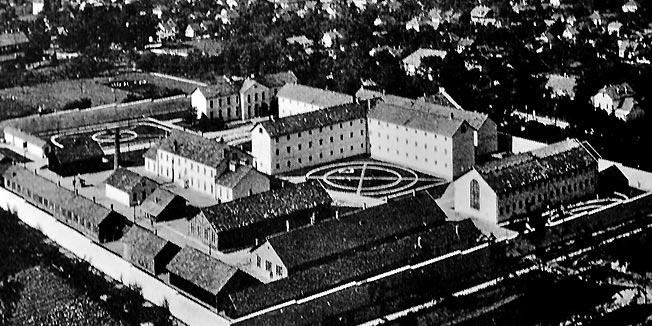
The Zenica Prison was the largest and most notorious prison in the former Yugoslavia. In its heyday, it housed over 5,000 inmates and formed an entire small town within the town.
Zenica – prison
It was a prison-dungeon, notorious for the harshest treatment, a place of torture, but also a place where numerous prisoners were liquidated. Thus, within the walls of Zenica Prison sat numerous writers, musicians, hundreds of Franciscan friars and nuns, priests and khawajas, thousands of Croatian women whose only fault was that they were the wives of Croatian soldiers, professors, doctors, boys, young men and anyone who did not please the UDBA and the Communist Party of Yugoslavia.
Zenica dungeon, torture chamber
In the basement, prisoners were chained in small alcoves, with cold water constantly dripping on their heads – today, human rights activists are suing the CIA for this method.
Deep underground, under the old prison pavilion, far from the eyes of the guards and other prisoners, is a huge basement hall. An irregular staircase leads to the interior of the earth, whose secret rooms have been hidden from public view for decades by a heavy locked door with a huge iron padlock topped by a massive doorknob. The guard on duty takes out a bunch of keys and inserts one of the more massive keys into the corroded lock, which finally clicks into place after two or three unsuccessful turns. After the creak of the heavy door, we are greeted by a long, dark and unventilated corridor, from which emanates a strong smell of dampness, mixed with the rot of the old beams that stand out in the sparse light of the bulb.
In the left wing of the basement room, whose floor is covered with bricks last laid between the two world wars, the guard stops. He spreads his arms over the empty, huge basement room and finally speaks, “Here is the Isusovača (a torture device, translator’s note) where the worst tortures were carried out on the prisoners of the Zenica prison.” Then he leads us two meters further to a massive damp wall, in which there are cavities the size of an adult man. Above each of these cavities hung a heavy, rusty chain with links at the end that resembled a primitive version of today’s police handcuffs. “This is where,” the jailer continued in his monologue, “the toughest prisoners were brought to soften them up. They were shackled with these chains and forced to stand upright all the time, with cold water constantly dripping on their heads, necks and backs.” To get a rough idea of this prison sadism, we crawl into a cramped room from which screams and wails rang out for years, mostly from political prisoners and religious leaders, but also from women, accused by the Communists of clero-nationalism. Standing in a confined space sends a person into a panic, and when chains and cold water are added to the mix, the torture in this dark and cold cellar, which has been guarded for years, is almost numbing.
Small alcoves where political insurgents, activists and opponents of the Communist regime were hanging chained day and night are carved into the left and right of the basement hall. The waterboarding in Zenica, the use of which by the CIA in American prisons has caused a huge media hype in recent years, was ten times worse, because in the “Isusovača” the prisoners’ hands were chained to the ceiling. In front of them, they could see part of the wall where light shone tentatively through tiny openings during the day. “Who knows how many prisoners died here. There are no official records in the archives,” the guard added after a long pause. Although, according to some researched data from the UDBA archives, more than 500 men and women died from severe torture and exhaustion between 1945 and 1990. Although, the number is certainly much higher, as most of these cases are concealed and unrecorded or no documentation exists. According to prison archives, the first devices for torturing prisoners in Zenica Prison were made by a construction technician named Plohović. There is not much information about the main constructor of the prison, not even his name is known. Archival records describe him as a short, fat and cheerful man who came to Zenica from Istria. He wore a large earring on one ear, which was extremely unusual for men at that time. The inhabitants of Zenica usually found him near the prison wall, where he was constantly taking some “strange measurements.”
Plohović, as he wrote in his book “Kazniona” (Penitentiary), designed and manufactured numerous torture devices that were used in prison. The most sinister were the “Rings of Jesus”. “Torture with the help of these shackles,” the book says, “seemed harmless at first sight.” The condemned man had to squat down, put his hands between his legs and hold on to his heels with his fingers. Then the guards shackled his hands and feet to the chains. For the first five or six minutes, the unfortunate man felt no pain. Then the first slight pains in his elbows set in, growing stronger by the second until it felt as if his arms would break. The severe pain in his hands was joined by pain in his joints and stomach. This was followed by severe blood pressure in the face, eyes, nose and mouth – the victims described this feeling as the soul in the nose. When it seemed it could get no worse, a terrible pain came from the spine area, as if strong forceps were tearing the spine.
At that point most people lost consciousness. Those prisoners who could remain conscious for more than twenty minutes on the Rings of Jesus were rare. This torture was also called hanging on the ground. According to the regulations in force at the time, a doctor had to be present when the punishment was carried out, because the torture could have resulted in the death of the prisoner. Today, the torture center in Zenica stands empty, there is no money in the Federation of Bosnia and Herzegovina for renovations of what would serve as a kind of museum, says the prison management. Only occasionally is this horrible place, choking with damp and rot, open for visits by delegations or press teams. Not many prisoners know about it either.
Editorial/crimesofcommunism.net