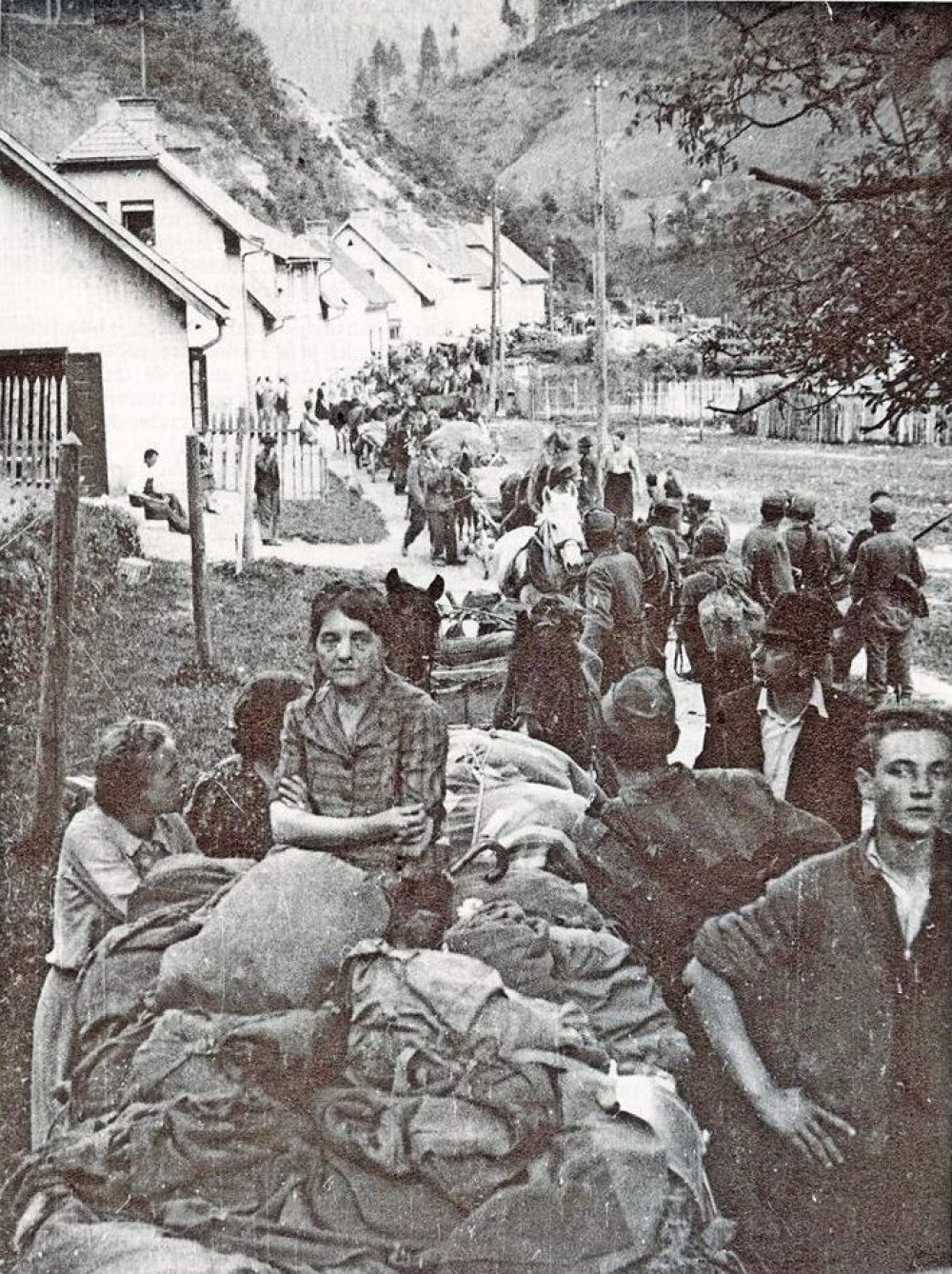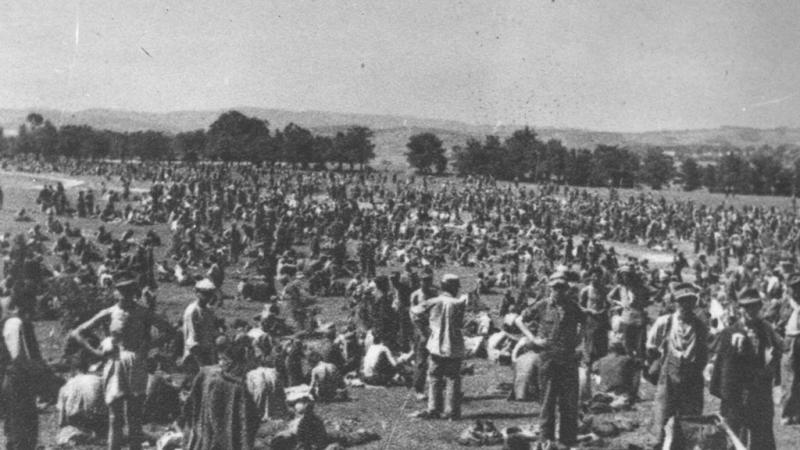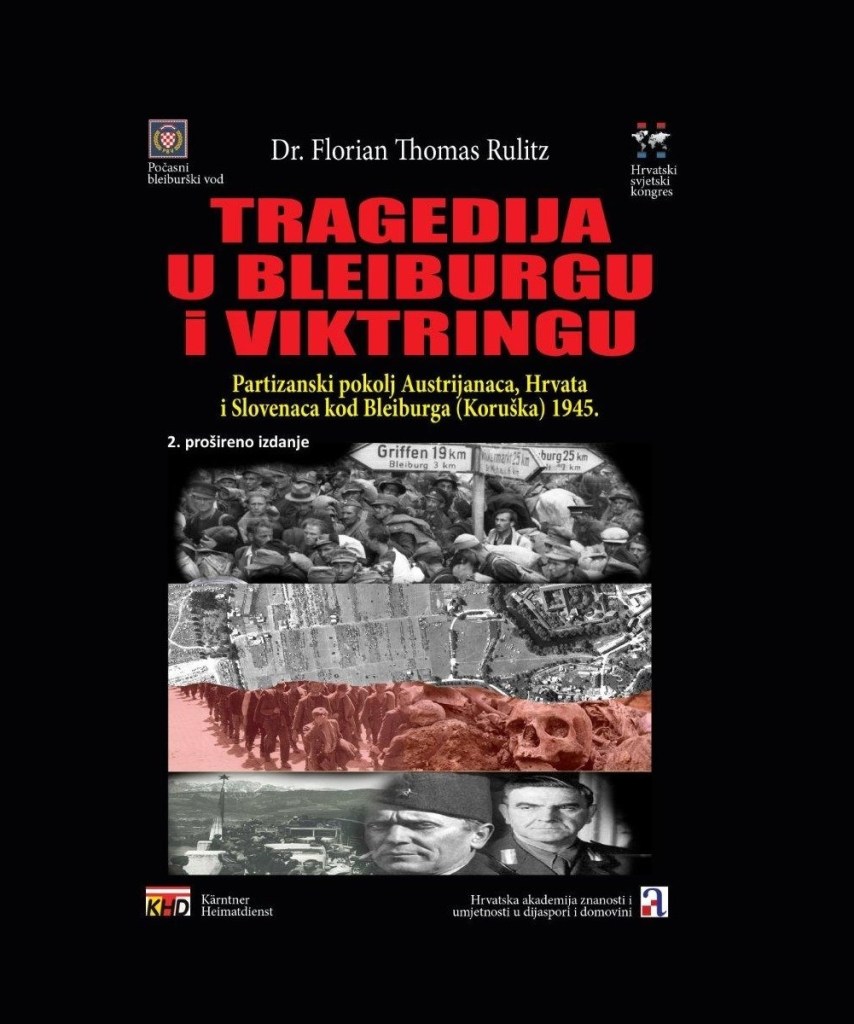



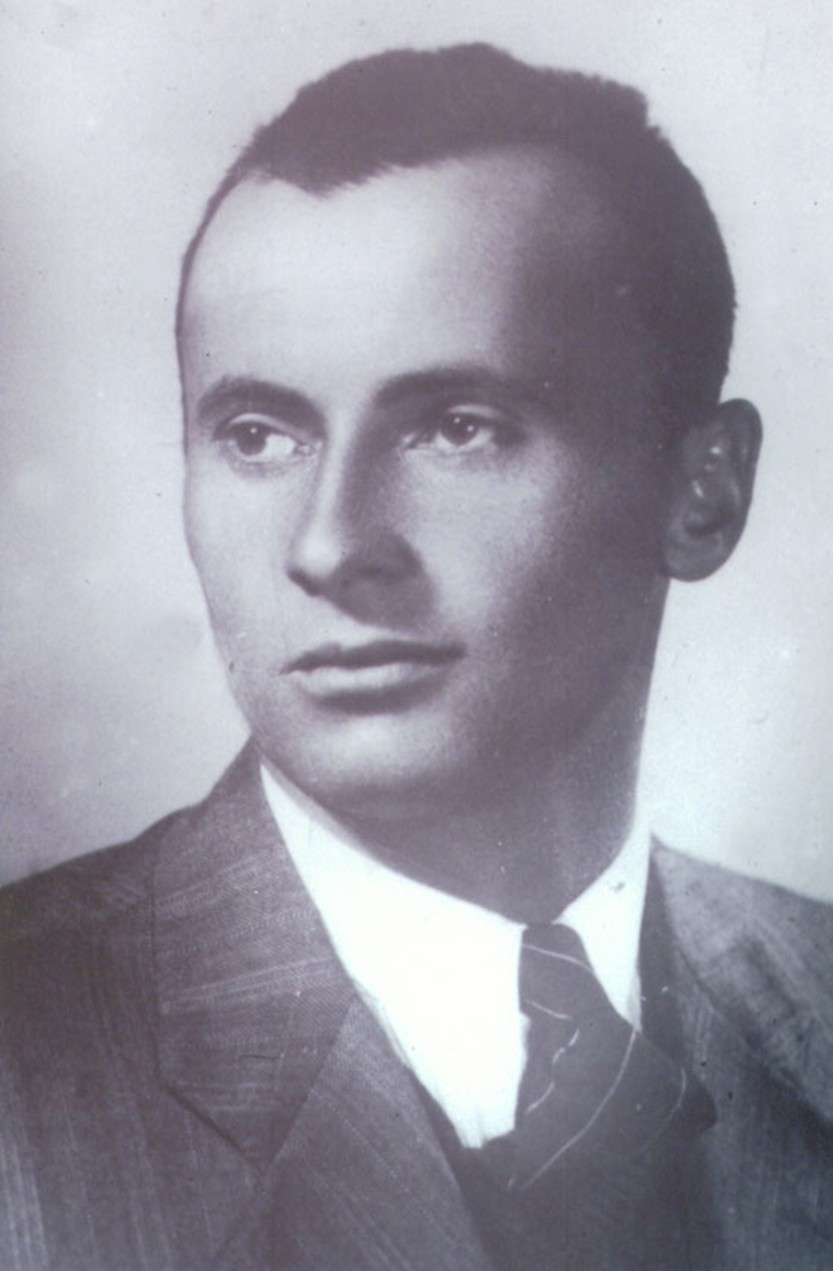


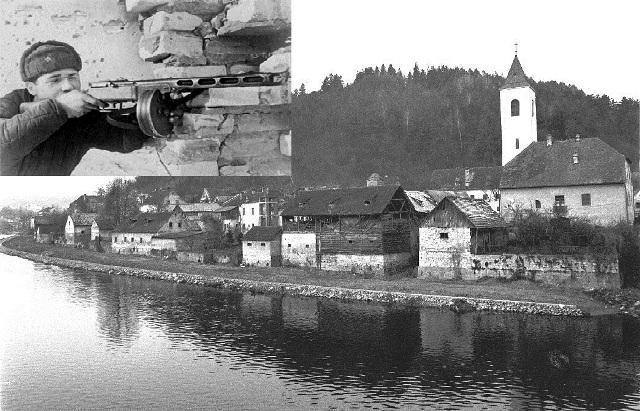
For illustrative purposes
River Una – Kostajnica
Document LXVIII
Testimony of Fuad Elezović Dervišev
In September 1942, I was mobilized into the Croatian Home Guard and served first in Zagreb in the Automobile Battalion, then in Sarajevo in the Auxiliary Company of the 111th Regiment, then in the Manned Battalion in Sinj, and finally back in my original (Auxiliary) Company in Sarajevo. After the fall of Sarajevo on April 7, 1945, we retreated via Zenica, Doboj and Derventa, where my group surrendered to the Partisans who had already entered the city. Seventy eight Home Guardsmen, two German Wehrmacht soldiers and six Italians, who went with the Germans as prisoners, surrendered with me. We went with the Partisans (the 7th Brigade of the 23rd Serbian Division) to Novo Selo. There we were registered. We all said that we were Home Guardsmen. They asked us about our profession and who of us wanted to volunteer to help them, for example, as mechanics and the like. To save our heads, we explained that we would volunteer to go with them. They did not ask the Germans anything, but took them out of a shed, already stripped to their underpants, and shot them in the middle of the day in a rake in some cornfields.
They were shot by a non-commissioned officer, probably a sergeant who had signed up for this bloody job. The order to shoot was given by the commander of the Escort Unit of the 7th Brigade of the 23rd Serbian Division named “Zećo,” a tall, mustachioed and handsome man who was always accompanied by his father in civilian clothes. More or less all the Partisans spoke Romanian and were from eastern Serbia, with a few real Serbs from the Kragujevac area. After the Germans, the Italians came into question, whom the Partisans also intended to shoot. I said to the sergeant who shot the Germans that he should not kill the Italians, since they were not guilty of anything and were only German prisoners. They then left the Italians alone, that is, they sent them to Derventa to repair a bridge. In Novo Selo, as in the rest of Croatia, the settlements were deserted, because people had retreated into the houses or somewhere else out of fear.
With the 7th Serbian Brigade, we prisoners also went to Prnjavor, where we rested for a while, then to Banja Luka, where we boarded the train at Kraljev Drum station and went to Prijedor. We spent the night in a Muslim village, where the locals received me kindly and invited me to dinner, but they were cold towards the Partisans. The next day we reached the village of Žuljevica via Blagaj, further from the road between the hills. In Bosanski Novi there were ongoing battles; it was defended by the Ustasha, Germans and allegedly a Circassian unit under the German command. The Partisans suffered heavy casualties, and I saw piles of bodies they had buried on the hills. The Partisans were frightened in the face of so many losses, and the commissars had to use pistols to prevent them from escaping and bring them back to their positions. The purely Serbian village of Žuljevica received the Partisans with joy and honored them. I remained the only one of the prisoners and was assigned a constant escort, while the rest of my comrades escaped or were assigned to other units.
Sometime around sunset, a group of Home Guardsmen in new German uniforms, about thirty people, came to us. They said that they were members of the 4th Mountain Company and that they had been ordered to defend a bunker, but they were cut off from their unit, which, however, had continued to retreat, having left Bosanska Kostajnica. Seeing no other way out, they reported to the Partisans and surrendered. I got into conversation with them and asked them if there was anyone from Herzegovina among them. A small man from Jablanica, a Muslim, came forward and showed me a picture of his mother and wife with a child on their laps in the courtyard on the cobblestones. I could not remember the others, because they were from regions I was less familiar with. The Home Guardsmen did not even suspect what fate awaited them, but they cut the corn, made a fire and warmed themselves in the cold spring night.
Just before these Home Guards, we encountered a Partisan unit on the state road from Kostajnica to Novi, near the crossing of the river Una. I recognized the commander of the unit on horseback in front of the company. It was Salko Alikalfić from Mostar, the son of Jusuf, the owner of the café “Paris” in Mostar. I spoke with him briefly and learned that Kostajnica had been occupied by Partisans that day. Nowadays, Salko is an aviation captain in Mostar. His brother Ismo, with whom I served in Sarajevo, was not present at the retreat, and persuaded others to surrender to the Partisans immediately because his brother was with the Partisans. He was unlucky because he was killed in Sarajevo as soon as he ended up with the Partisans, who killed him together with his Croatian prisoners and comrades. Commander Zećo, who had received the surrender of the above-mentioned Home Guardsmen, ordered that wire and string be looked for, in order to tie up these 30 Home Guardsmen. The decision was made to kill them on the spot. When they started to tie them up, the Home Guardsmen begged them not to be killed, because they were innocent and some of them had wives and children at home. However, it did not help. Zećo ordered his regular liquidators to put an end to the prisoners. Thereupon 6 or 7 people with Russian Schmeissers jumped up, took the unfortunate prisoners into the darkness, perhaps 50 meters from the Una in the direction of the railroad line, and opened fire on them. We heard the shots and the groans of the people and clearly saw the glint of the rifle shots. After that, a few single shots were fired, probably to hit those who were still alive. After some time, the killers came back with their still bloody pants, blouses and belts, on which the bullet holes were still clearly visible. The liquidators were young men, 20-21 years old, with the exception of two even younger ones, 18 at the most. They were the most famous killers who participated in every shooting and both of them had medals, one of them all blond, unlike the other Partisans of the Romanian language. I mention him mainly because later, near Samobor, I was supposed to be shot by the same person, but I managed to overpower him and escape. On the contrary, his dark-haired friend killed my companion, who was to be shot together with me.
I left from Bosanski Novi with the escort company of the 7th Brigade to Dvor, where we spent the night, and then to Gvozdanjske and Glina. The next day, we went to Sveta Nedelja via Rakov Potok. We met some Partisan units on the way, including the medical unit of the 25th Serbian Division. The wounded were taken away by cart. Partisan nurses, mostly from Serbia, and various volunteers from Bosnia, also Serbs, took care of them.
The leader of a Partisan unit was a local peasant. When he declared he could go no further and had to return home, and they found another leader, a commander ordered him killed, which was done immediately in the nearby forest. We arrived to Sveta Nedelja in the evening and stayed there until the morning of the day after tomorrow.
The next morning, after breakfast, Commandant Zećo told us that we were going to be “reassigned” to another unit. We did not suspect anything bad yet, until the order came to tie us up. Now it became clear to me. I threw myself on the ground, I did not want to be tied up, and I kicked and punched. The guide, who said to tie us up, hit me twice with a heavy military shoe, cursed something obscene, but still let us untie. The whole scene was observed by the aforementioned Daničić. We walked out of the village, accompanied by the two bloodiest liquidators who followed 23 meters behind us. They had hand-held machine guns with them. As soon as we left the village, we headed towards a forest on the left. I whispered to my friend that we should run away because they would take us to be shot. He refused and said, “I will not,” because he believed the commander’s word that we were being reassigned. As soon as we entered the woods, I turned abruptly, threw my Home Guard blouse over my escort (the blond and frail young man with the two medals), which I carried over my arm due to hot weather – the day was very nice and warm – and then hit him with full force in the head. I took off running, at top speed, deeper into the woods, along the side. Behind me I heard gunshots, with which, I think, the black-haired companion killed the Home Guardsman. By the time my blond executioner regained consciousness, I had already rushed out of the forest and reached another grove in the field through a small clearing, while shots rang out around me. They fired not in bursts but one at a time, no doubt in haste and confusion. At the end of the forest, I looked around again as I flew as fast as I could across an open field and into a deeper, larger forest. I hid in the deep brambles, in a light shelter, and I heard them searching and calling for me in the distance.
Later they did not make the other Partisans look for me. I suppose that these two liquidators declared in the company that they had carried out the liquidation and thus protected themselves from objections. I stayed in my dugout all day and night and the second day until evening. I had nothing to eat or drink and drank my own urine out of thirst. Later I learned that there was some water nearby, of which, of course, I had no idea. Believing that the escort had already moved on, I took courage and walked out of the shelter to a farmer in a vineyard. After a half-hour conversation, in which I lied, out of fear, that I was a Partisan who left the hospital in search of his company somewhere in Slovenia, he took me to his house on the other side of the road from Samobor to Zagreb and gave me milk and cornbread. By chance, a patrol of a Partisan artillery unit stopped at the same house. Since I did not have a discharge bill from the hospital, they first took me to their command and from there to OZNA in Samobor. There I was handed over and found myself in a circle of detained civilians and soldiers, of some 150 or 200 people. They just asked me if I was an Ustasha or Home Guard. I was there for two days and two nights. When I learned from the commander, who was from Žumberak, like his OZNA informants, that some civilians would be sent home and given a pass for their place at the window, I brazenly mingled with these lucky people and got a pass to Mostar under my real name. It had a stamp with a five-pointed star as well as the recommendation that I should not be disturbed during the trip, but on the contrary, that I should be helped.
While I was in a closed space, I cut out a five-pointed star from a red cloth and sewed it on my Home Guard cap. This way I could leave the prison freely, a few times a day, unhindered by the guards. On my way into town, I discovered that there was a concentration camp for German and Croatian soldiers in town, somewhere at the end of town, to be exact. Again, with the help of the magic five-pointed star on my cap, I entered the camp unhindered, where there were perhaps a few hundred people at that time. Among them I recognized my compatriot from Mostar, Safet Ćustović, and his brother-in-law, his sister’s husband. At first they thought I was a Partisan. Since the camp had had nothing to eat for two days, maybe more, they asked me to bring them something to eat. I went to a few houses and got potatoes and salt from the people in Samobor. I took everything to the camp and gave it to Safet Ćustović (his father’s name was Rešid and he was the turnkey in the city prison in Mostar) and some Germans, and one of them gave me a pair of pants in very good condition and shoes, because my clothes were completely torn. When I told Safet that I was going to Zagreb, he asked me to go to his wife and sister in Zagreb, Preradovićev Trg 3/IV, which I promised him I would do. There was still no strict discipline in the camp. However, sometimes, groups of selected people were taken out of the camp “on orders.” There was a suspicion that they were actually taken away to be shot, because near the city, in the forest, one often hears shots, although the fighting has already stopped and Zagreb is already in the hands of the Partisans. During one of my visits to the concentration camp, a professor from Zagorje, I think from Konjščina, told me that people are being killed when the shots from the forest are heard. I certainly cannot confirm this for each and every case, but I saw with my own eyes, for example, how the Partisans beat a young man from the Honorary Labor Service, who was defecating under a bridge outside the camp, until he bled to death. The Communists accused him of trying to run away and beat him so severely on the head with fists and revolver grips that his friends later had to carry him into the camp because he could no longer stand on his feet. However, the second case is even more significant. As I had promised Ćustović, as soon as I received my pass, I immediately set out for Zagreb, which had already been in Tito’s hands for 2 or 3 days. I immediately went to Ćustović’s wife, found her and her sister-in-law at home, and told them about my encounter in the Samobor camp. They asked me (they were very scared) to give them until tomorrow to prepare some food for the two of them in Samobor. During the night they prepared halva, roasted meat and the like, and the next day before noon I went back to Samobor. I found no one left in the camp, because they had all already been “transferred” somewhere and supposedly gone to Karlovac. I was convinced that people had actually been killed. The Partisans were very bloodthirsty at that time. I did not have the courage to tell Mr. Ćustović’s wife and sister this very unpleasant news, and I carried on without telling them anything. Later, when I came to Zagreb a few times, I asked Mrs. Ćustović about the fate of her husband. She told me that after that last message he never called again. Both he and his son-in-law were executed for sure by the red executioners, probably the same night.
With my pass, I went home by bus from Zagreb via Slunj, Šibenik (we spent the night there and the OZNA locked up all the passengers of the bus from Zagreb except me because I was allegedly a Partisan soldier), Split, Livno, Bugojno (there I got on the train), Travnik, Sarajevo to Mostar. There, two days later, I was caught on the street by a patrol unit, and since I could not show them the pass from Samobor, which contained things about me that were obviously untrue and known as such in my hometown, they first locked me up in the police station and then handed me over to the OZNA prison in Šantić Street. I was interrogated the most by the UDBA Ensign Gavro Papo from Mostar, who is now a high UDBA official in Sarajevo. I spent two days in UDBA’s prison and then a day later I was transferred to the former Ćelovina City Prison and finally to the Northern Camp, the main place for the capture and interrogation of military and civilian persons. I stayed there for 15 days. I witnessed daily how the suspects with more serious allegations were selected and taken in an unknown direction. According to the reports of people inside and outside the camp, many of those taken from the northern camp were liquidated somewhere and were never heard from again because they were obviously killed. Some were taken from my room for trial, who used to be some officials in the Croatian government or whose daughters were married to some important Ustasha. Pero Musa, for example, a merchant from Mostar, was a man with no position in the state, the apparatus, or the Ustasha movement, but his daughter was married to Ustasha Staff Sergeant Barbarić; he got 20 years in prison. Also from my room was Jozo Merdžo, who held a state position and also received 20 years, while his brother Ivan received a slightly lesser sentence, but in any case an outrageously high sentence, disproportionate to the crime he was accused of. They were among the most respected Croats from Mostar, and that is why they were punished in this way. The commander of the camp was Tasko Zurovac, a Serb from Mostar who now lives in Zagreb. The officers of the camp were mostly Serbs from Gacka and Bileć. I cannot end my testimony without mentioning my meeting in Zaječar with the aforementioned Partisan Daničić. While serving in the army under Tito, I came to Zaječar in April 1948 to work as a mechanic on the highway. While unloading military supplies at the train station, I came into contact with a group of peasants in national costume waiting for the train. I immediately recognized the Partisan who had kindly helped me dig the ditch in Pisarovina. I approached him and asked him if he knew me. He replied that he knew me, but did not know from where. I introduced myself and told him about the event. He was very surprised and told me that he was convinced that I had been liquidated together with the other Home Guardsman near Sveta Nedjelja. I then told him how I had escaped certain death. He invited me to visit him in his house. He told me to go to the village of Kobišnica and ask for Trubač. That’s him and everyone knows him. His last name was Daničić, while I forgot his first name. He told me that he would tell me exactly about the people who wanted to kill me. The blond liquidator is still alive today and is from Donji Milanovac. He knows them on orders and all the other bloodthirsty people from the support unit 7th Brigade of the 23rd Serbian Division. At that moment the train came and he said goodbye to me. I never saw him again.
I have read the above statement, the truth of which I vouch for with my signature.
Fuad Elezović Dervišev
Rome, April 18, 1961
Source:
John Ivan Prcela, Dr. Dražen Živić, Hrvatski holokaust dokumenti i svjedočanstva o poratnim pokoljima u Jugoslaviji, Zagreb, 2001.
Uredništvo/crimesofcommunism.net