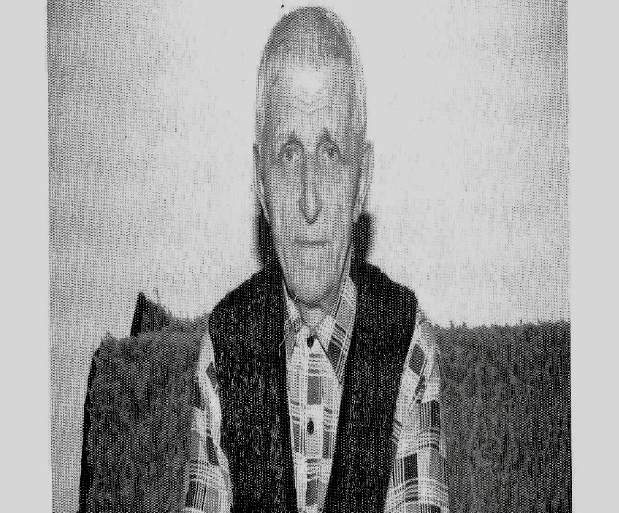



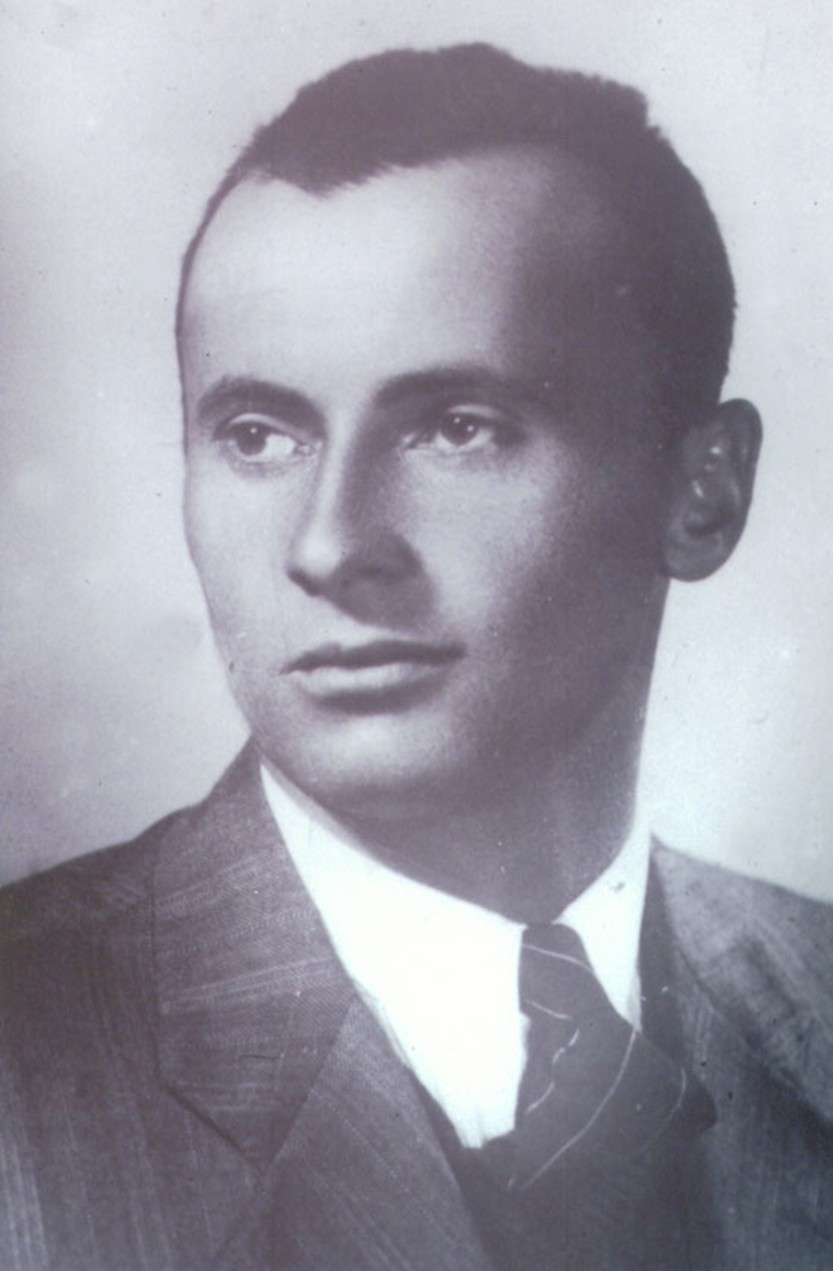


Gojko Bošnjak in 2018.
Gojko Bošnjak
Gojko Bošnjak, born February 14th, 1934 in Široki Brijeg.
Gojko Bošnjak, a Croatian emigrant, spent more than three decades of Tito’s Yugoslavia in exile in Germany because the Yugoslav communist government labelled him a “fighter against the state and the people”. His life often literally hung by a thread. He survived two assassination attempts by the infamous UDBA; they offered him to switch to the “right side”, and they tried to use his family against him. He had his first problems with Tito’s regime at the age of fourteen, when the communist authorities took his father Božo away to serve a three-year prison sentence.
He was in detention from 1949 until 1951. He was a rebel and he didn’t want to join a workers’ association. His father was a famous miller with thirty years of experience working in his own mill. He did not join the army, nor was he a supporter of any army. As a 21-year-old, Gojko was sent to serve his military service in Užice in April 1954. Thanks to a “maneuver he undertook with his colleagues”, he spent 18 months in the JNA instead of the required 24 months. After returning from the army, he got a job at Novogradnja and reached the position of the chairman of the board. But, soon thereafter, new problems arose: he fell out with the director. The director ‘advised’ him that he must protect the management, and not concern himself with the workers. He simply wouldn’t have it. He soon applied for a passport with the intention of going to visit his cousin, Ivan Buntić, in Germany. His wife Iva was first to inform him that he should go to Mostar to get his passport. This news found him at work, at the Čitluk Winery. In Mostar, he was greeted by Mirko Praljak, the father of General Slobodan Praljak, who gave him ‘instructions on how to behave in Germany’. After about an hour of conversation, however, he told him that he would have to wait for his passport because not all the papers from Lištica had arrived yet. After two weeks, he received a rejection note.
There was a great desire in him to leave a regime he did not feel was his. Thanks to his friend Marko Ćorić from Donji Graci, who “arranged” his passport, Gojko set off for Germany. But first he stayed in Zagreb for four weeks. He spent four weeks in the apartment of his friend Mladen Mandić on Petrinjska Street. The apartment was located near the headquarters of the Zagreb UDBA. He arrived in Germany, more precisely in the town of Karlsruhe in the Upper Rhine Valley, in October 1961. Thanks to his cousin Ivan Buntić, he immediately got a job on a construction site. As he did not have a proper visa, he was fired after only a month, so he looked for another job in a town a hundred kilometers away.
After three months of waiting, he was granted a residence permit and returned to his old job in Karlsruhe. In early February 1962, he completely “severed ties with Yugoslavia”. Together with his wife Iva, who joined him in Germany thanks to papers arranged by his friend Marko Ćorić, he reported to a refugee camp and asked for political asylum. This was a sign to the Yugoslav communist government that he was obviously working against the state and the people, so he became their target. They started considering him an Ustasha, even though none of his family were Ustasha. His only crime was his national consciousness.
He quickly adapted to the German way of life, order, work and discipline. First, his cousin Ivan Buntić opened a restaurant where Gojko’s wife Iva also worked. She learned the trade so, in 1970, with the help of his cousin, they decided to open their own restaurant in partnership with Božo Plazibat from Dugopolje. Just before the restaurant opened members of the Yugoslav communist government tried to “buy” him. By orders from Belgrade, via Luka Slišković’s father-in-law, the Mostar UDBA made him a business offer and invited him for a meeting anywhere outside of Germany! However, he did not waver in his plan. Only two years later, in 1972, two agents of the Mostar UDBA visited him again in his apartment, and offered him whatever he wanted just to cross to their side. There was no price that would buy him. Gojko took 50 DM out of his piggy bank and gave it to them for lunch, to make up for the energy wasted trying to recruit him.
He made a living from hard work. He was not a terrorist he was labelled as. People gathered around him in his bar. Among the patrons were quite a few prominent people from German society, including the Attorney General, the German chief justice and numerous emigrants. His business success could not be forgiven. They thought he was helping emigrants in his bar and inciting them against Yugoslavia. Because of all this, in the summer of 1972, they planted a bomb in the stairwell of his restaurant and timed it to go off at the end of working hours. The bomb detonated four minutes late and exploded at 11:04 p.m., when he and all his employees had, fortunately, already left work.
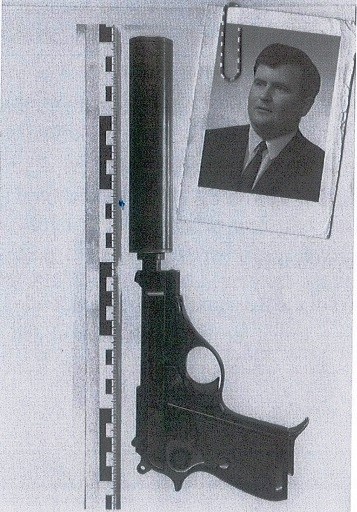
In another attack, it was his former compatriot who tried to kill him. The second attack on Gojko Bošnjak took place on December 28th, 1973, when he was returning from grocery shopping for his restaurant. While taking groceries out of the car, he noticed someone walking behind him. He didn’t pay too much attention to it until he felt a touch under his shoulder. Something seemed to click. He turned and saw the assailant holding a silenced pistol behind his back. Fortunately, he managed to resist him. His gun jammed and he wounded himself. They wrestled and rolled around the yard for almost fifteen minutes. Gojko managed to detach the silencer from the pistol and, holding the assailant firmly to the ground, waited for the police.
At the time of the attack on Gojko, one of the guests in his restaurant was Ante Roso, later a Croatian volunteer and general, who immediately wanted to deal with Gojko’s assailant. Gojko’s attacker was his fellow citizen, Vlatko Mišić, from Ljuti Dolac, five years his senior, who received orders from agents of the Mostar UDBA, Petar Manojlović, Stipe Grizelj and Rade Vukojević. A year later, on May 11th, 1974, Vlatko Mišić was sentenced to ten years in prison at the Karlsruhe District Court for the attempted murder of Gojko Bošnjak. Vlatko Mišić was known in UDBA circles under the pseudonym “Vran”. After serving his sentence in Germany, Vlado Mišić was deported to Yugoslavia. At the beginning of the war in Bosnia and Herzegovina, he joined HVO units.
Despite this, the threats didn’t stop. On two occasions he found dozens of cigarette butts in his basement, probably from potential assailants awaiting his arrival. They kept coming to his apartment, one of them was even his cousin, who was playing with his children whilst figuring out how to kill him. After that, he never let anyone in again. He hung out with Bruno Bušić, the Bušić couple and Gojko Šušak. During his time in political emigration, he had the opportunity to make friends with numerous Croatian political emigrants. Bruno Bušić, Gojko Šušak and Zvonko and Julienne Bušić were just some of the politically like-minded people he enjoyed spending his days with. In her autobiographical book “Lovers and Madmen”, Zvonko’s wife Julienne Bušić mentions, among other things, Gojko and his bar in Karlsruhe.
Gojko Bošnjak was often the main topic during sessions of the Municipal Committee of the Communist Party in onetime Lištica. He found out about it on one occasion, when an unknown mole sent him an anonymous letter to Germany, informing him that a showdown with him was being prepared. He returned from political emigration for the first time in 1992, when he and his friends delivered humanitarian aid to Krk, and then to his native Široki Brijeg later that year. He celebrated his freedom and the freedom of the Croatian state and its people with his wife, surrounded by relatives, friends and other political emigrants, in the old house of his father-in-law Luka Slišković in Mokro.
Sources:
Anto Kovačević, A Man and His Shadow, Zagreb, 2012, and Bljesak.info
Editorial board/komunistickizlocini.net