


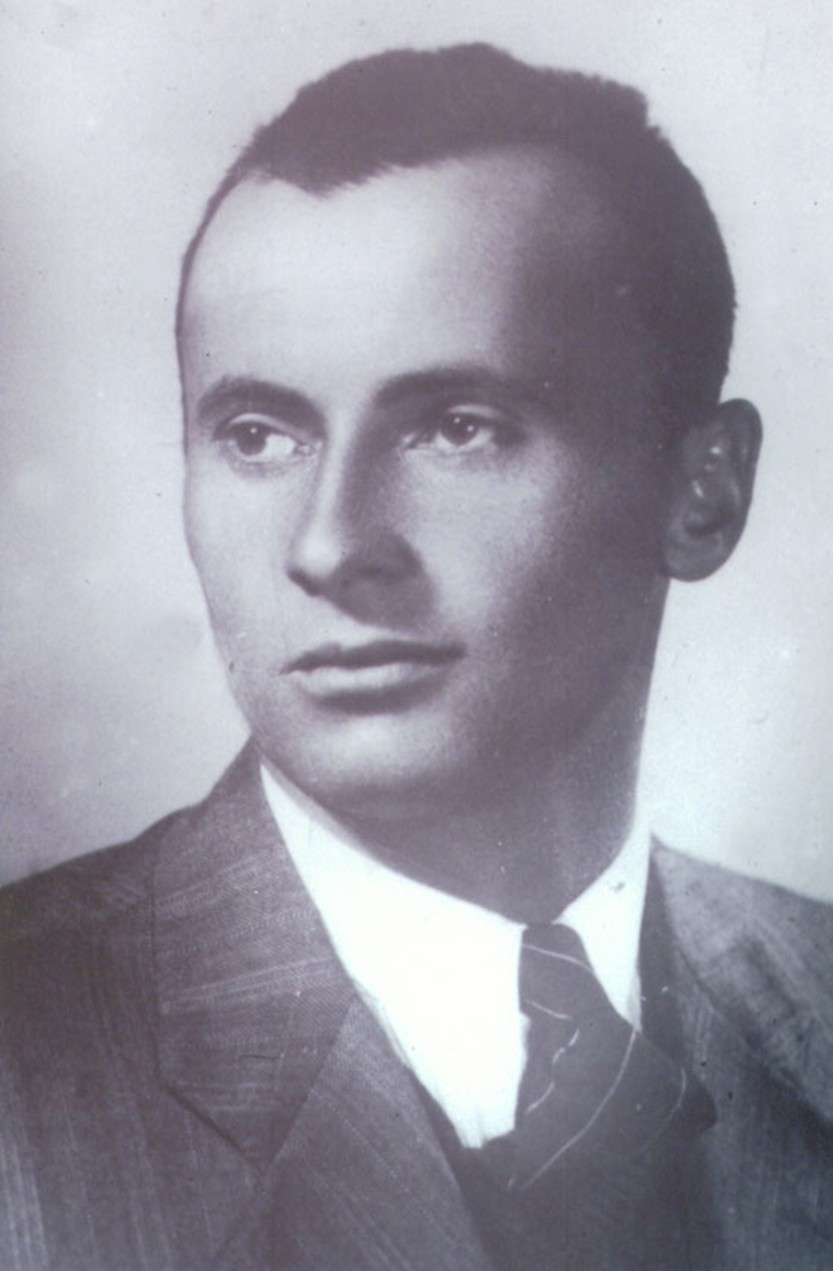


Cvitan Galić i Franjo Kluz
Two morals
Addendum to the book about Croatian pilots
In the last wars fought on European soil, little has remained of the former chivalry of war, when one looked the enemy in the eye and won or lost one’s life in an equal fight. Fighter pilots are among the few who have retained their old military honor.
During the conflict between an English aviator and the “Red Devil” Manfred Freiherr von Richthofen, an eighty-time winner in air duels, German “Red Devil’s” machine gun failed. The English aviator noticed this and came very close. Recognizing the “Red Devil” as his opponent, he waved his hand at him, laughed heartily and flew toward the English formations.
Croatian aviator Cvitan Galić from Gorica near Posušje was one of the greatest heroes of the skies in World War II. One day, the commander of the aviation regiment in Banja Luka ordered Galić to follow Lieutenant Franjo Kluz in his high-speed plane and shoot him down immediately if the warning that Kluz wanted to defect to the Partisan camp in Bosanski Petrovac proved true. Galić followed Franjo Kluz to Bosanski Petrovac, flew past him and waved at him to dissuade him from his plan. However, he did not want to bring him down. When he landed in Banja Luka, Cvitan Galić told his commander in confidence, “I cannot kill my colleague, I let him go.”
These and other examples of military honor by airmen are presented in the book Hrvatska krila (Croatian Wings, t.n.).
The Zagreb newspaper Vjesnik published a multi-part reportage about Franjo Kluz on one occasion. In the reportage, the two “victories” of Franjo Kluz in the air are described in detail and triumphantly. Vjesnik writes that in the first days after his escape he continued to fly in a plane with Croatian markings. One day he noticed two Croatian planes, he waved at them, they waved back at him in the same way, so they joined up in flight and flew in the same formation. As soon as he was behind them, Franjo Kluz pulled the trigger of his machine gun and mowed down two Croatian colleagues who were unsuspecting. Afterwards he told how they were writhing in death shock in their seats. Those were the only two air “victories” of Franjo Kluz that Vjesnik wrote about. The names of many streets and enterprises today bear Kluz’s name. Cvitan Galić had 46 recognized war victories. After the arrival of the Partisan authorities in Zagreb, his grave, like those of all other Croatian soldiers on Mirogoj, was plowed up, so that today one can only guess the place of burial. The commander, Colonel Franjo Džal, was hanged in Belgrade, many ace pilots were shot dead and some were sentenced to long prison terms. During the Yugoslav Communist regime, the family was not allowed to maintain and restore the grave.
Cvitan Galić, Croatian Air Force ace. He has a total of 38 confirmed and 7 unconfirmed victories.
Cvitan Galić was born on 29 November 1909 in the village of Gorica near Posušje in a family of nine children. He finished elementary school in Sovići and from 1927 lived with his uncle, a doctor, in Stolac and worked as a miller and mechanic. Soon after, he joined the infantry of the Royal Yugoslav Army in Posušje. As an outstanding student at the military school, his application for transfer to the Air Force was approved. In December 1930, he graduated from the aviation school in Mostar with excellent results in the 7th Aviation Regiment. In 1932, after serving in Skopje, he was accepted into the Fighter Pilot School in Zemun on the basis of his proven abilities, where he completed his training for air combat. He also worked as a flight instructor. On August 1, 1935, he was appointed a fighter pilot.
He married Ana Vocel on March 29, 1937. He built a family house in Zemun, which was confiscated after World War II. He also had two daughters, both of whom died in their first year of life. His military career was also marked by frequent conflicts with Serbian officers, with whom he came into conflict because of his pronounced Croatian national feeling.
When the April War started, he served as an aviation sergeant at the Kosor auxiliary airfield near Mostar. He then worked in the 3rd Pilot School of the Air Force of the Army of the Kingdom of Yugoslavia. After the outbreak of the April War, he flew to the airfield near Sinj and made himself available to the Croatian Air Force Legion. He volunteered for the Croatian Air Force Legion, where he was assigned to the 4th Air Fighter Group. He went to Fuerth near Nuremberg in Germany for special training. After the training, on September 28, 1941, he joined the 10th Fighter Squadron (the 4th Fighter Squadron of the Croatian Air Force Legion).
His unit was sent to the southern sector of the Eastern Front. He won his first victory at the end of November of the same year. He won a major victory on April 17, 1942, when he shot down the then-best Soviet MIG-3 fighter. At that time the Squadron achieved its 50th victory, and on June 21 it completed its thousandth flight, which was recorded by the press and radio of the time. In early July of the same year, the Squadron was equipped with the most modern fighter aircraft Messerschmitt Bf 109 G (G – Gustav). On August 1, 1942, Galić shot down another Soviet fighter, and in the course of the same month three more aircraft. The number of all Džal Group victories rose to 100 recognized aerial victories. In September, Galić shot down four more Soviet aircraft.
The balance sheet notes that they achieved 164 victories in 3000 combat flights, with six pilots killed. The most successful ace of the Džal Group then became Lieutenant Cvitan Galić, who achieved 29 recognized victories in 407 flights. He was awarded the Military Order of the Iron Trefoil 2nd Class with oak leaves, and the German command awarded him the Iron Cross 2nd and 1st Class. For a short time he served as commander of the aircraft fleet in the 1st Flying Group of the First Airport in Zagreb at the Borongaj airfield.
By mid-February 1943, the majority of Croatian airmen were in the Crimea and continued to operate from the Kerch airfield. Lieutenant Galić soon achieved his 32nd air victory in April. He was awarded the German Cross in Gold for his past achievements. Galić achieved his last aerial victory on June 5, 1943, when he shot down two Soviet fighter planes in one day. Under the influence of Soviet propaganda, several aviators defected, which is why Lieutenant Colonel Franjo Džal was discharged.
The veterans of the Džal fighter group were recalled to a new assignment in their home country by the Staff of the Air Force Legion. The best will become commanders of fighter squadrons in the NDH as well as instructors at flight schools. Galić ended his career as a fighter pilot with 38 recognized victories and 7 unrecognized victories achieved in 439 combat flights. In Zagreb, at Borongaj airfield, the 11th Fighter Squadron was stationed in the 1st Airport. Due to the large losses of German Messerschmitt Bf 109 G-10 fighters, the Croatian Air Force received much weaker French Morane-Saulnier M.S.406 fighters captured by German forces in late 1943 and early 1944. They were used to form new squadrons with veterans of the eastern battlefield. Cvitan Galić received the rank of first lieutenant and was soon appointed commander of the 23rd Fighter Squadron of the 5th Airport of Banja Luka, which protected the area under the control of the said port and scouted and fought Partisan positions.
Because of the great importance attached to the outcome of the war in the Balkan Peninsula, the British Air Force frequently bombed targets in the NDH area. Many fighter squadrons were flown by Serb pilots who had transferred to Cairo as Chetnik formations. In the early months of 1944, the Royal Air Force of Great Britain began a series of operations over the territory of the former Yugoslavia in support of the Partisans. Units of the Desert Air Force were especially engaged in the bombing from the air, firing machine guns, and supplying the Partisans. About forty German and Croatian aircraft assembled at the Zalužani auxiliary airfield to attack the Partisans’ supply and communication lines. The 2nd Squadron of the South African Air Force conducted an attack with Spitfire aircraft on stationary Croatian aircraft at the Zalužani airfield. Lieutenant Cvitan Galić attempted to take off and join the fight. One of the bombs fell next to his plane, in which he was already sitting, causing the plane to burst into flames. Lieutenant Cvitan Galić’s body was transferred to Zagreb and buried in Mirogoj on April 8, 1944. The commander of the NDH Air Force, Colonel Adalbert Rogulja, delivered a farewell address over the open grave. Posthumously, Galić was promoted to the rank of Flight Captain and awarded the Golden Medal for Bravery and the right to the title of knight. Upon their arrival in Zagreb, the Partisan authorities destroyed his grave.
Franjo Kluz (Jošik, Bosanska Dubica, September 18, 1913 – Omiš, September 14, 1944).
He graduated from elementary school and civil school in Bosanska Dubica. After that he worked for a short time as a clerk in a law office and then joined the Air Force. He graduated first from the engineering school and then in 1939 from the non-commissioned officer pilot school. At the beginning of the April War in 1941, he was a pilot of a reconnaissance squadron at Rajlovac airfield near Sarajevo.
After the surrender of Yugoslavia, he joined the NDH Air Force, but soon joined the Communist Party in Banja Luka; he supplied the Communists with money, weapons and other material, and waited for the opportunity to fly over into Communist territory.
After the capture of Prijedor and Ljubija in May 1942, conditions were created for the transfer of Franjo Kluz and Rudi Čajavac to the Communist army. Franjo Kluz got his chance on May 23, 1942, when he was supposed to transport medicines from Banja Luka to the Croatian garrison in Sanski Most on the Potez 25 biplane. Instead of Sanski Most, according to Communist sources, he landed in Urije near Prijedor, while according to other sources he landed in Bosanski Petrovac, an area under Communist control.
Beginning on August 18, 1944, Kluz flew several sorties from Cana airfield in Italy. He bombed towns and ports in Dalmatia and parts of Bosnia and Herzegovina, and provided protection for Partisan aircraft.
He died on September 14, 1944, when he was shot down by anti-aircraft fire while leading four “Spitfires” in the bombardment of Omiš.
The decree of the Presidium of the National Assembly of the Federative People’s Republic of Yugoslavia declared him a so-called “People’s Hero” on May 18, 1948.
Sources and literature:
Nova Hrvatska, No. 22, London 1975, 15.
Bruno Bušić, Jedino Hrvatska, collected works, Toronto, Zurich, Roma, Chicago, 1983.
jabuka.tv, April 7, 2015, accessed January 8, 2023.
vojnapovijest.vecernji.hr, March 21, 2016, accessed January 8, 2023.
Editorial/crimesofcommunism.net