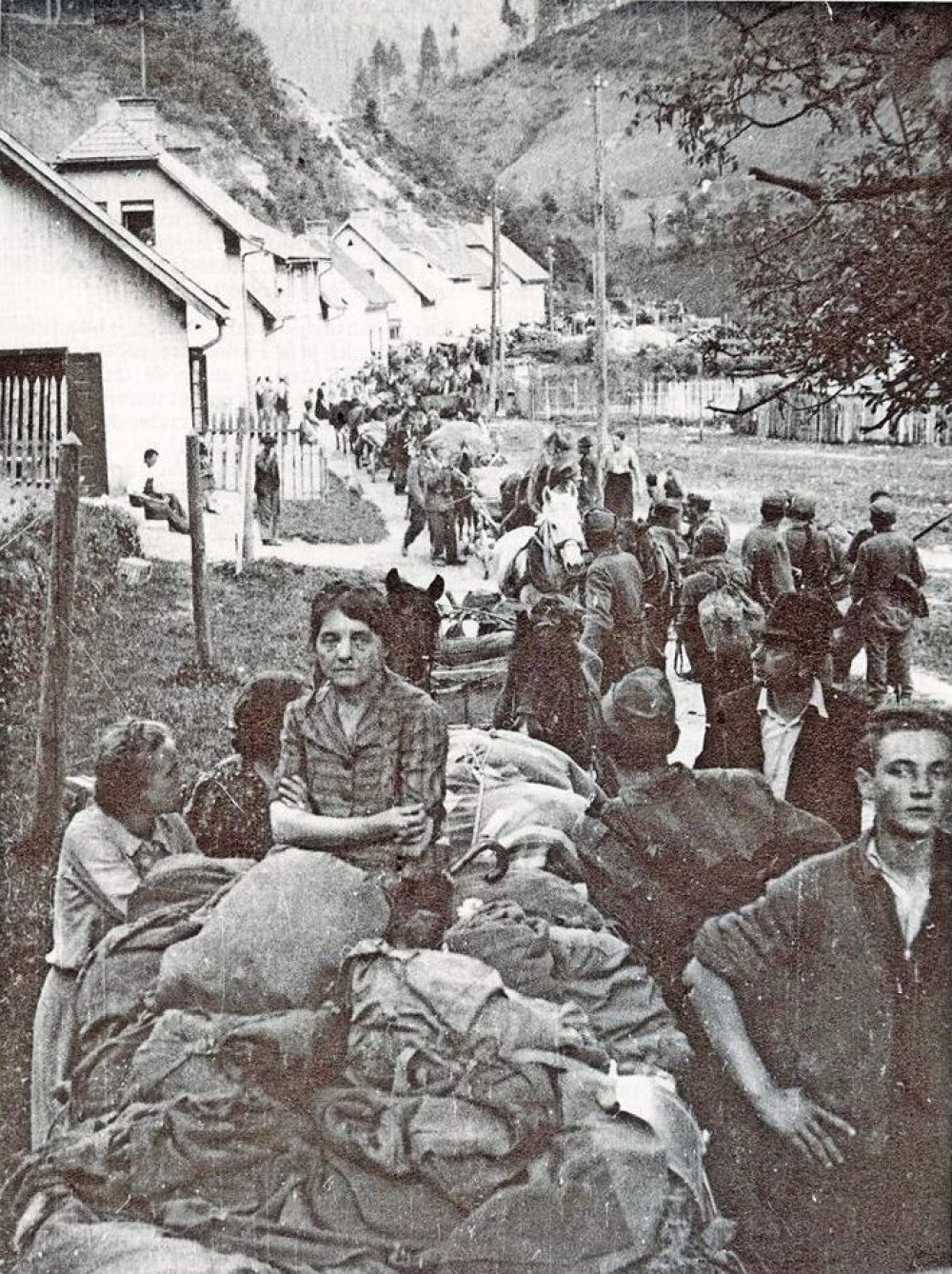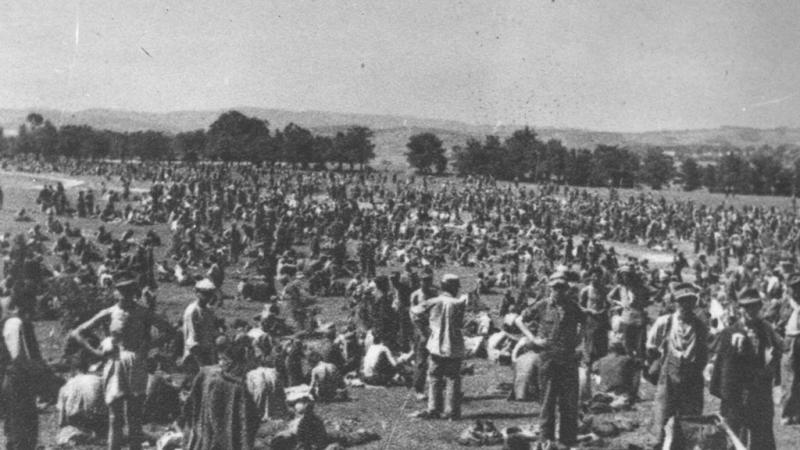





Bistrica, source safarić.si
Impol factory
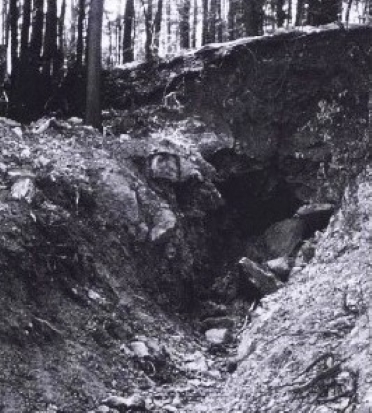
The partisans brought Croats from the Way of the Cross in groups to the Impol factory and pushed them into the factory’s air raid shelter that was built by the Germans. It is assumed that the number of victims is around 4,000 although some sources mention the number even as 7,000. Once the air raid shelter was full, they mined the entrance; people were dying in agony. Those who were not killed by the explosion died of suffocation!
“The air raid shelter was full of corpses. The military uniforms they wore could be clearly recognised, uniforms of the Croatian Home Guard, civilian suits… A mother cradling a child… The corpses were packed in like sardines and had not been fully decomposed. The decomposition began once the corpses came into contact with the air”
In 1948, the communist regime dug out the remains of those victims and incinerated them in the large oven of the “Impol” factory. The reason for the exhumation is unclear but it is thought that the communist authorities at the time planned to conduct some works in that location and that the hidden remains of those victims represented an obstacle or they wanted to fully hide their crime. The exhumation and incineration was done by the prisoners sentenced to death, who were liquidated at the end of their task except for one who managed to survive and testify about this serious crime. Namely, Srećko Bolčić from Žeževica in the Croatian south. Besides this large group of people that they killed in such a bestial manner, there are in this area also a larger number of pits, trenches and bunkers in which they also liquidated hundreds of people.
Bones found in the bunker; 233 victims

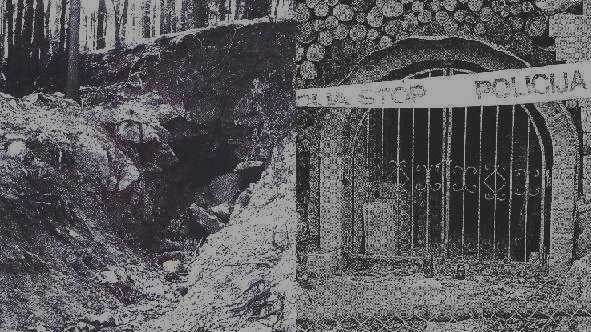
In 2002, the team of the Ljubljana Institute for Forensic Medicine exhumed 233 victims of the communist regime from the bunker In Slovenska Bistrica. The mortal remains were placed into bags and temporarily stored in the nearby nuclear shelter of the Impol company. Since a much greater number of remains was still under ground, the firm ERGE-ING from Velenje stopped the exhumation until the final location of the remains is determined. The entrance into the old bunker is fenced off and entry is not allowed, as marked by the police warning ribbon.
On a small hill above another mass grave sits the house in which Franc Simončič lives today with his family. He recounted to us that a lot of dust was raised in Slovenia after this horrific discovery, and that although still reluctantly and in fear, people mention also the names of local partisans whom they suspect for the unseen mass crime. They all mention Franc Kac. Regarding this, the name of Franc Kac from Gornja Bistrica is most frequently mentioned, for whom the older people say that as member of the OZNA in 1945 and 1946, he participated in the mass slaughter. Besides the Croats, some Slovenians were killed there, it is estimated a total of some 4,000 people among those who were suffocated and incinerated, as well as hundreds of victims from pits, bunkers and trenches in this area. Franc Kac did not feel safe in this location. For this reason, in the fifties he moved to Portorož where he allegedly lived at the time – said Simončič and added that it is indeed a case of a large mass grave from which during the recent exhumation the whole area stank despite the fact that more than half a century has passed since the tragic event.
Then, in Slovenska Bistrica they managed to find Kristina Skrbinek (87), sister of the suspected Franc Kac. At the time, she had heard him via telephone several months ago. She knew that he lived in Portorož, but he did not tell her where he was calling from. He had not been in touch for several months and nobody knew where he was. All of this was a great pressure on him and it was talked that he escaped to Germany – said Katarina Skrbinek. The Slovenian police also has information that Franc Kac no longer lives in the territory of Slovenia. Kac’s sister Kristina was not willing to discuss her brother and his alleged participation in the massacre of thousands of people. She said only that he was in the partisans, but that she knew nothing about his actions because he never told her anything about it. She added that she follows what the Slovenian press is writing about all this and that she find it difficult. Zdenka Cerar, State attorney of the Republic of Slovenija, stated that the accused Kac should be heard but that he is unavailable at the moment because he no longer lives in Slovenia.
According to the tragic discovery of the Slovenian weekly “Demokracija”, around 7,000 corpses of Croats were burned in the Slovenian Auschwitz. According to “Demokracija”, on OZNA’s orders, the prisoners of war burned around 7,000 bodies of killed Croatian and Slovenian soldiers and civilians in the Impol factory in Slovenska Bistrica. For several decades now there have been rumours in Slovenska Bistrica about how several thousand Croatian and Slovenian soldiers and civilians have been burned in the furnace of the Impol factory, but these events never achieved public confirmation until now, let alone the judicial responsibility of someone or some. And how could a public confirmation have been achieved, or judicial responsibility sought, when it is common knowledge that this incineration, together with mass post-war killings (historians estimate that after the Second World War 200 to 300 thousand people were killed in Slovenia), was the most closely guarded secret during the long decades of the previous regime.
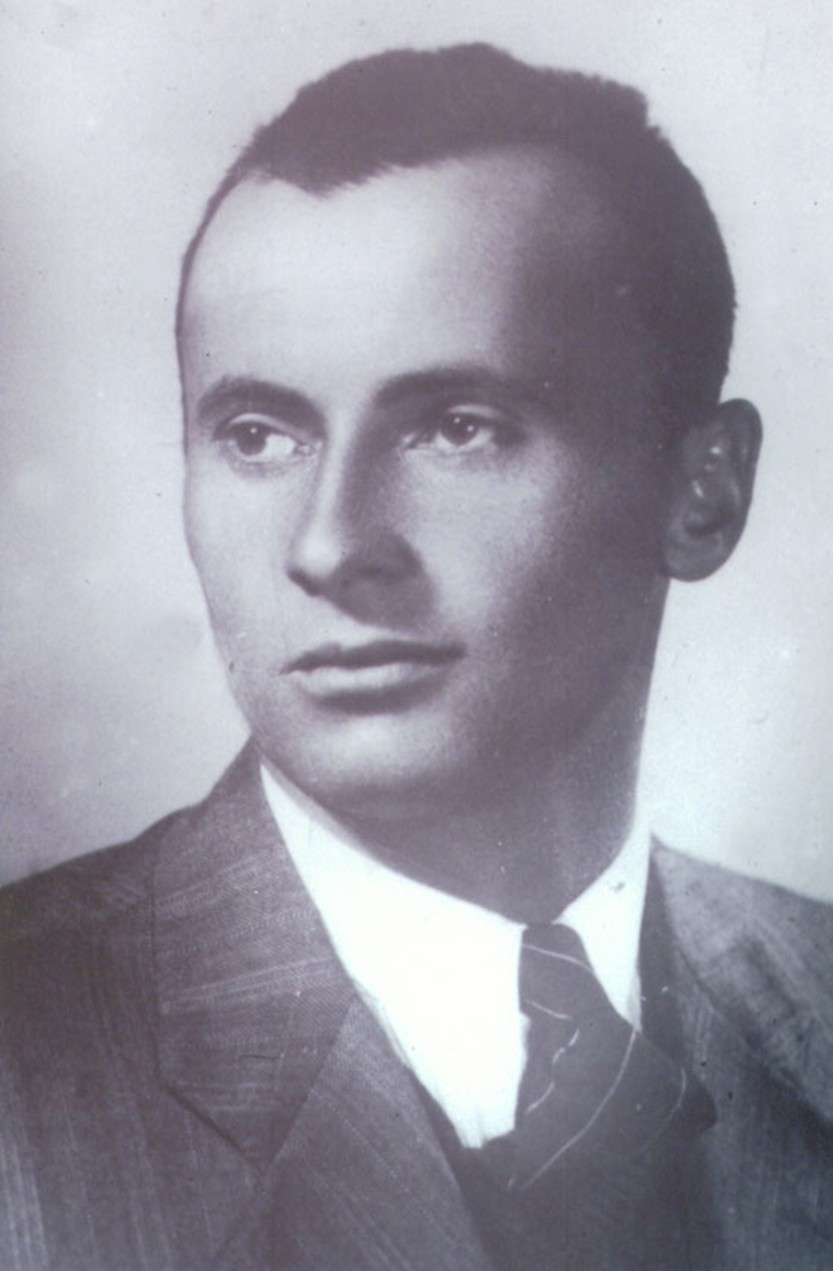
Something more is known about the mass killings only after the independence of Slovenia, when besides some official data also the shocking testimonies of participants come to light. “We burned also corpses”. One of such testimonies is that of Croatian former prisoner Srećko Bolčić, who told everything to his cousin Marko Troglić under the condition that he can publicise it all only once both Bolčić and his father had died; Troglić published it on 18 February 1976 in the Croatian-Canadian weekly “Hrvatski glas”. In this testimony, Troglić describes the tragic course of Bolčić’s life. He was born in 1930 in Žeževica in the Croatian south, and in 1958, as one of many post-war emigrants went to Canada. Only two years later he died from head injuries that he suffered during the time of his captivity in Yugoslavia. Towards the end of the war, for fear of the partisans, his father left home and nobody of the household knew where he went. Srećko, a 15 year old lad at the time, decided to find his father. He joined the column of Croats who were escaping from Yugoslavia and with them arrived to Dravograd. In this mass he met his cousin who proposed that he returned home.
“I took his advice and returned to Križevci. They came for me and took me away. They said that we shall search for my father together and that they will not let me out of prison until we find him. From then on until 1948, they moved me from prison to prison, from village to village. Petar Bolčić: Several of us from the shabby shelter loaded bodies onto the railcars and others pushed them to the factory where they burned them in the big furnace. There were another 50 prisoners in my group. As a prisoner, I had to do all kind of jobs, among those even burn people’s bodies”, recounted Bolčić to his cousin. This is where the most shocking part of the testimony begins. “One day we arrived in Slovenska Bistrica, where we were allocated jobs. Some started to dig up the covered shelter in the hill, others were laying railway tracks for small railcars. After several days of digging, a large opening emerged in front of us from which came a foul stench. The stench was so strong that we could not continue to work without masks. Once we tidied up the entrance to the shelter, despite the stench, we came to a horrific sight which I will not forget to the end of my life.
The air raid shelter was full of corpses. The military uniforms they wore could be easily recognised, unforms of the Croatian Domobran, civilian suits… A mother cradling a child… The corpses were packed like sardines and had not fully decomposed yet. Decomposition started once the corpses came into contact with the air”, continues Bolčić. Bolčić soon found out the destination and purpose of the tracks for the small railcars. “Several of us loaded the corpses into the cars, others pushed them to the factory where they burned them in the big furnace. Many of us fainted because of the unbearable stench, and some of those who did, finished up in the furnace together with the corpses. Police guards told us that none of us will return home because we will all finish in the furnace.” Probably he too, like the other prisoners, would have finished in the factory furnace, but for the intervention of his cousin’s acquaintance, a high positioned Croatian communist who also wrote down the testimony. This is how Bolčić describes the days when he was finally set free: “When they let me go, I went to a Slovenian house in the neighbourhood and begged for some food. They gave me bread and apple juice because they had nothing else themselves.
They knew what kind of job I did in their vicinity, so I asked them how did all this begin and how many people were killed there. The host told me that the factory worked for the Germans during the war and that this was a shelter in case of air raids. In May 1945, the partisans brought the Croatian army soldiers there together with civilians, women, and children. They ordered them to enter the shelter with the explanation that they will spend the night there and continue on the road tomorrow. Once they packed them all into the shelter, they placed mines at the entrance. The strong explosion completely buried the entrance so that everyone in the shelter suffocated. The Slovenian told me that there were around four thousand soldiers, civilians, women and children in the shelter, continues Bolčić. The tragic story of Srećko Bolčić corresponds fairly precisely with some currently recognised and researched facts. Namely, it is a fact that during the recent excavations in the trench near the Impol factory in Slovenska Bistrica, the researchers of the Ljubljana Institute for Forensic Medicine came across railway tracks very similar to the ones described by Bolčić, even though there was never any mine in this area. The location of the shelter is also very well described – at the start of the hill and next to it the Impol factory.
Impol did, as Bolčić righty states, work for the German Army during the Second World War, and the bunker in the vicinity of the factory was build as a shelter. The claim about the mining of the entrance to the shelter, of which the Slovenian who fed him spoke to Bolčić, also appears correct. At the hearing before the Parliamentary Investigative Commission for Post-war Crimes by Dr Jože Pucnik, Franc Kac, the authorised member at the time of the head of OZNA for Maribor – right hand side hill (where also Slovenska Bistrica belonged), stated that his intelligence agent told him that the second larger liquidation in the shelter took place in the winter in 1945 or 1946, when for three nights lorries kept bringing people into the shelter”. One of the inhabitants of Slovenska Bistrica, who was only a child at the time, stated that one winter night an officer came into their house and asked them to open all the windows and doors because there would be a great explosion. This in fact happened. In the morning they saw that the shelter was blocked up. It is very probable that Bolčić indeed saw the children of Croatian Domobran and civilians in the shelter.
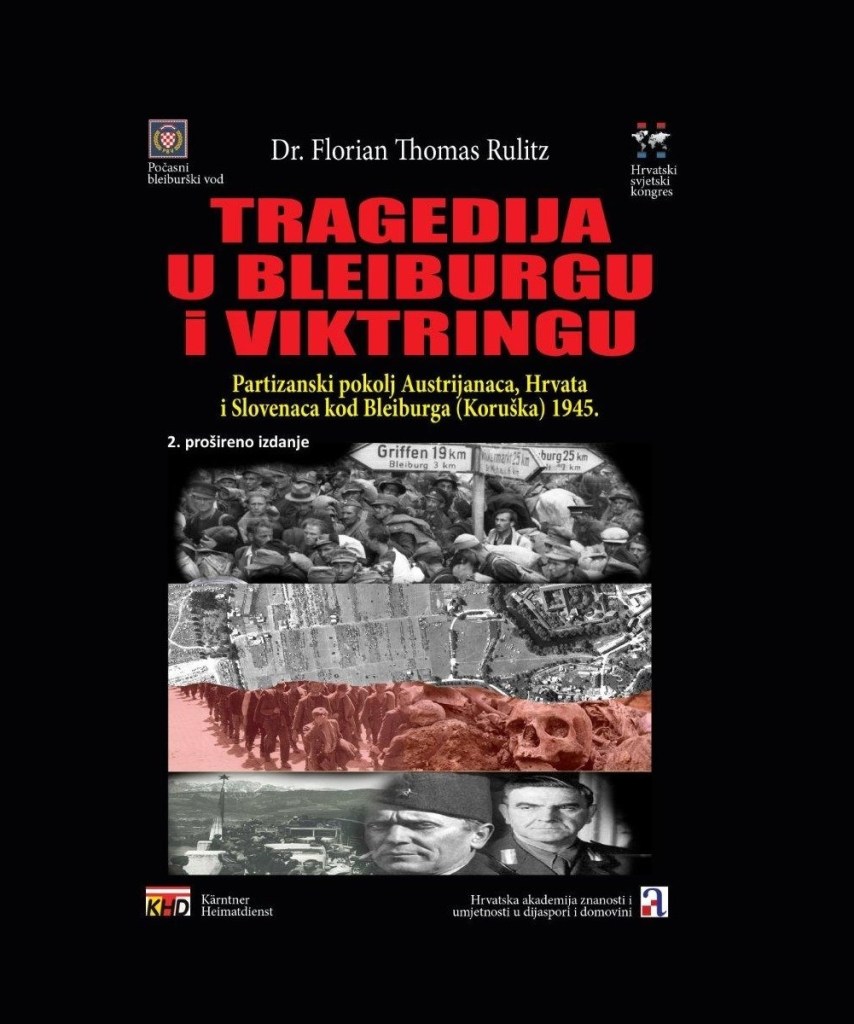
In fact, around one week before the end of the Second World War in the vicinity of the small Carinthian place Pliberk (Bleiburg) not far from the Slovenian border, the well known mass liquidations took place. Today it is known that thousands of people were taken from that column also to Kočevski Rog, where they are still today finding their skeletons. Skeletons were discovered also during the building of the motorway near Tezno, and human remains from that “death march” mass slaughter can be found scattered all around that area. It is almost certain that several thousand persons were brought to Slovenska Bistrica, barely 20 kilometres from Maribor. The corpses that Bolčić burned belong to that group. The story about the burning of corpses in the Impol factory is not the only one of that time. According to the account of one surviving witness, in 1945 the Slovenian OZNA allegedly took 98 children of the ages between two and fifteen years of age from Celje. The children were brought at dawn to the clothing factory Lisac in which soldiers uniforms were disinfected at the time. According to the witness statement, the commander separated 18 eldest children and 80 were closed in the plant and gassed. The account of this case should soon be published in a book, similarly to that about the burning of Croatian soldiers and civilians. Sufficient “material” for historians and court experts alike. So that it never happens again.
Sources:
Slovenska Demokracija.si Thursday, 18 October 2001
Eve, Maribor, Wednesday 3 October 2001
Franc Perme, Tudi mi smo umrli za domovino, Ljubljana, 2000.
Safarić.si
Editors/crimesofcommunism.net