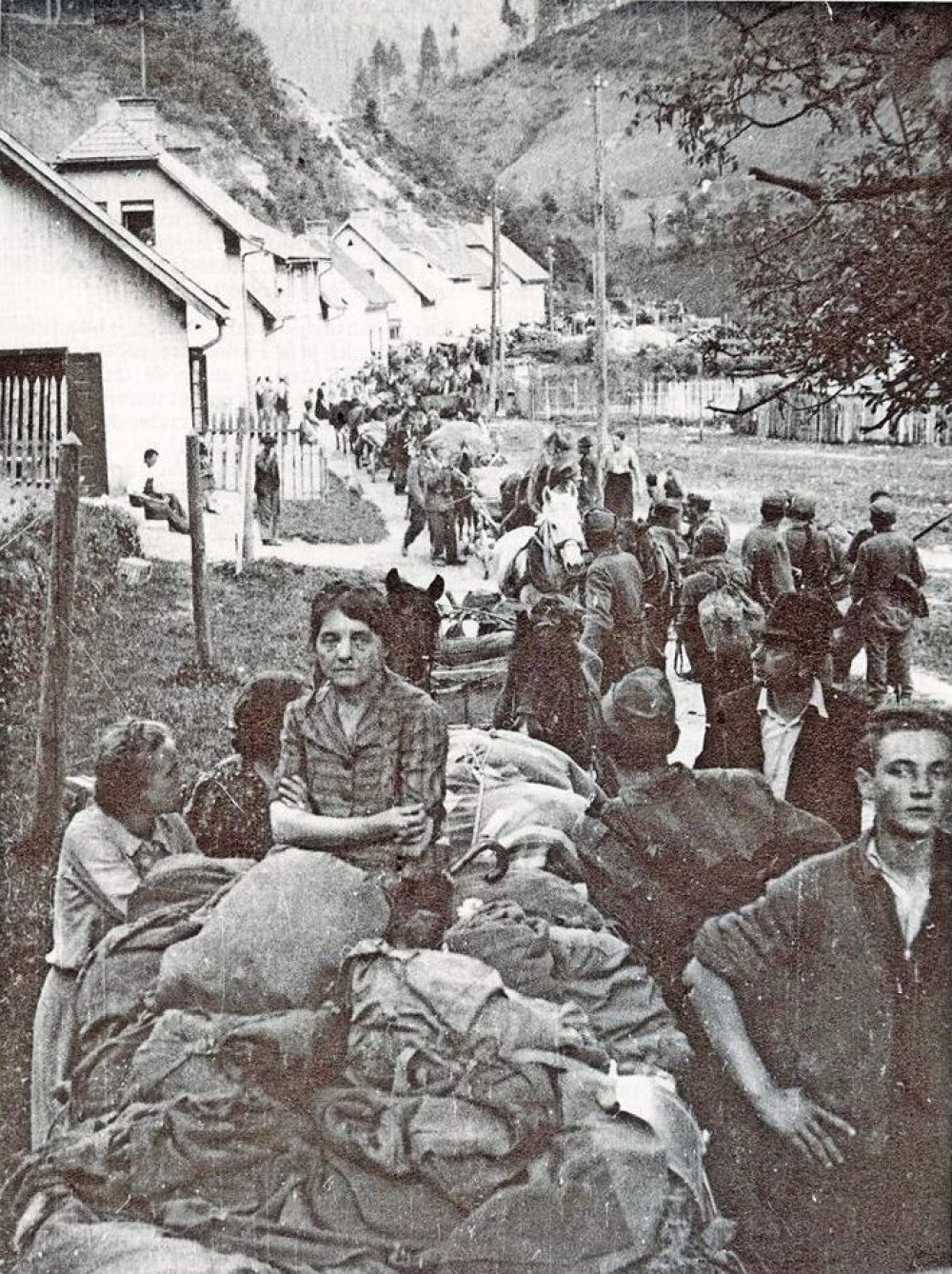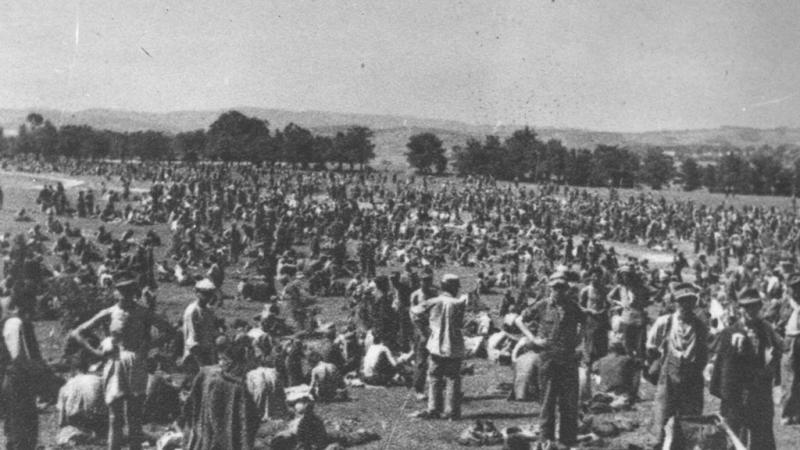





Partisans of the 29th Herzegovina Division after entering Nevesinje in 1945
Nevesinje
Memories of Hasan Tanović
I was born in Nevesinje, in Herzegovina, a nice, small town, which in my early childhood was inhabited almost exclusively by Muslims of whom there were more than 75 percent. Some five percent were Croats. The rest were Serbs.
The war came in 1941. I was still a boy then. There were three brothers – one was my father, Hajdar Derviš, the other Suljo Sulejman, and the third was Ahmet.
One day in 1941, Ahmed went to Mostar with a friend, the son of a butcher, Trbonja… On the way to Mostar, in a canyon-like pass in Bišina, the two were jumped by Serbs, and thus became the first victims of Nevesinje. They were burned alive. They turned them upside down and lit a fire under them. Neither of them would ever hurt a fly. They did not owe anyone anything, nor had they ever done any harm to anyone. War was a terrible thing.
The war went on, and so came the year 1945. On February 14th, 1945, the partisans allegedly liberated Nevesinje. And people came out to greet them. However, my mother had a premonition and hid me and my father in the attic. The partisans entered the town. People greeted them in the streets. Kadrija Konjalija, secretary of the Committee of the Communist Party in Nevesinje, also joined the crowd on the street.
What I saw with my own eyes was horrendous. The attic window had a view towards the municipality building. It had a yard. Father and I were watching what was happening. The partisans gathered all the Muslims and Croats, lined them up, and placed a machine gun in front of the line. The Hoja was also there. There were about 30 – 40 people, that’s how many I saw, anyway. The window was open and I had a perfect line of sight. A partisan stood behind the machine gun… And in front of him were people who had come out to greet and welcome “the liberators”. The two smarter ones among them realized what was about to happen. They were Sejdo Saračić and Bey Bašagić. They threw themselves on the ground before the machine gun fire started and mowed down all those people. I watched with astonished child’s eyes as the grocer Enver Ljubović, who was around 27 – 28 years old, suddenly bolted and ran away from the line! An officer fired his gun at him, once, twice, thrice, four times – finally hitting and killing him.
Then he checked to see if anyone was still showing signs of life. They finished off one victim with a bullet to the head. Bey Bašagić and Sejdo Saračić came to our house, unnoticed through an alleyway, later that evening…
The large Tanović family house is there, and Gašo’s house is tucked away behind it. Bašagić and Sejdo Saračić came from that direction, as if returning from the dead, telling us how everything went down, and how they threw themselves on the ground when the shooting started.
Let me retract… We came down on the second day, as the civil government started functioning, and you could go about town. I went to the bridge towards Pahlevina, where Bjelica had his property. I saw Kadrija Konjalija, killed, with his brains blown out.
A total of 189 Muslims, aged between 10 or 12 and 60, were killed that day. Some managed to hide, but most did not. All of the Croats were also killed. Three female members of the Kolakov family were also killed on the order of that Kljakić woman, mostly because the latter was jealous of girls who dated officers…
Almost everyone was killed in 1945, on the day of the liberation of the town of Nevesinje, February 14th, 1945. A black cloud appeared over us, and they were all beheaded and killed. All those killed were civilians. Artisans, merchants, people who were not active in any army. All the wounded military men, housed in our big house, were killed by a bullet to the forehead.
Looking at this today, comparing and analyzing what happened in 1945, clearly it is a continuation of 1918, that is, the continuation of the formation of a greater Serbia, and a continuation of the cleansing; in fact, they never stopped thinking about how to cleanse us. Of the percentage of Muslims and, partially, Croats in pre-war Nevesinje, less than 18 percent remained as of 1945.
No one ever spoke or made statements about the people who were killed during those days. Most likely, they were not allowed to utter a word.
The day after the event I described, my father, Salko Korkut and Hamzo Kazazić loaded all the murdered people onto cattle carts, they dug a large common grave, and buried them all together…
What is the condition of that common grave today?
Nevesinje had a knitwear factory built. There were as many fields as anyone wanted, but the authorities took part of the burial site to build the factory on it, on top of the bones, so that the bones wouldn’t be moved now that the pits started to be opened, because, surely, someone would have remembered this one and asked for it to be opened. And so, the Nevesinje factory was built right on top of the bones.
The burial site was cut in half and, to make matters worse, it was used as a pasture for livestock, and the fence was knocked down… We later fixed it up as best we could.
Two mosques, Dugalić’s mosque and Trebović’s mosque, were turned into warehouses. We continued to maintain the Emperor’s mosque, which served its purpose, but the other two that were converted into warehouses probably still have that function, if they are still standing, that is, which I doubt.
In Varaždin, November 1992
BEHAR (Zagreb), issue no. 3, November/December 1992, pg. 10
Editorial board/crimesofcommunism.net