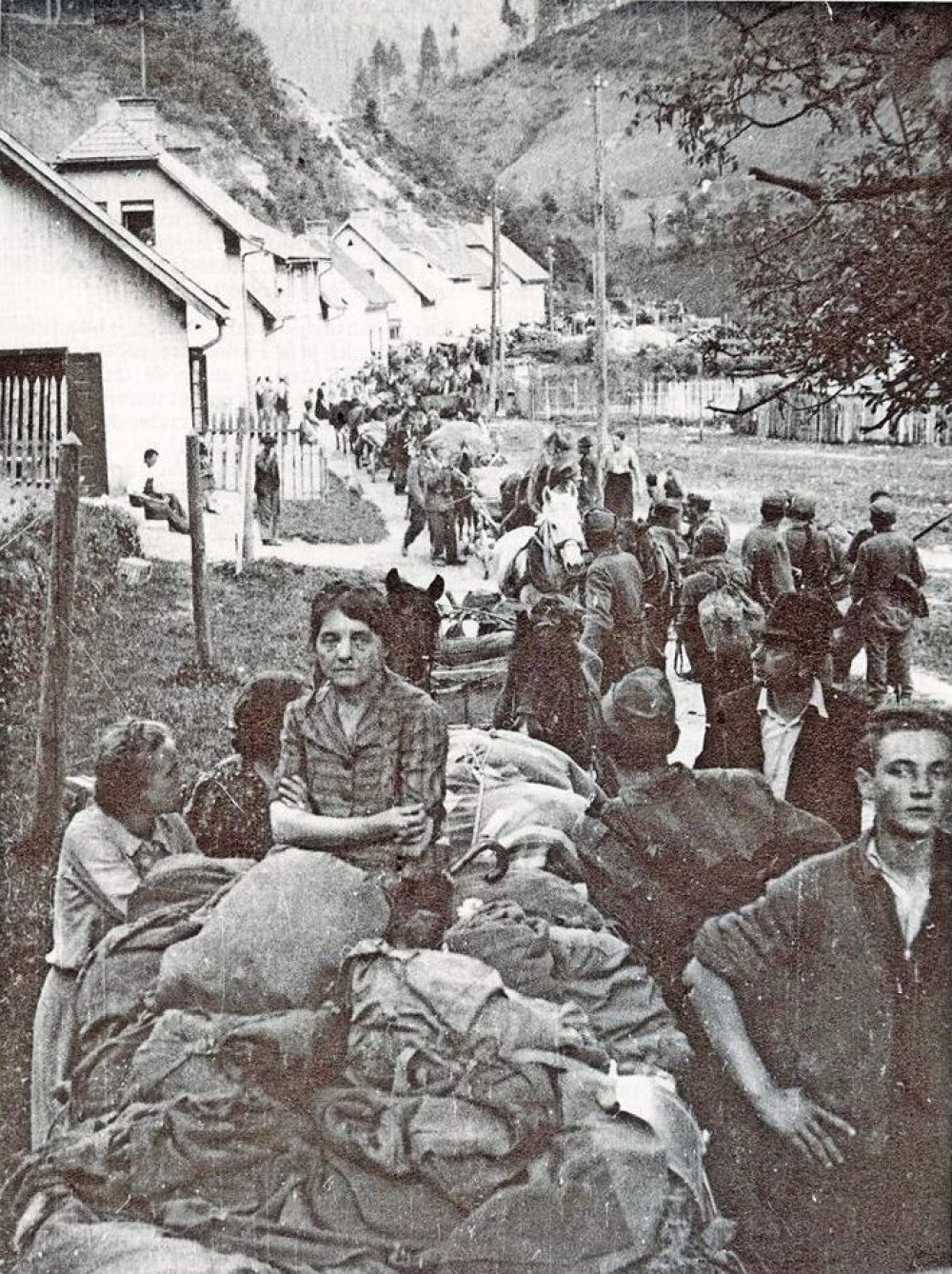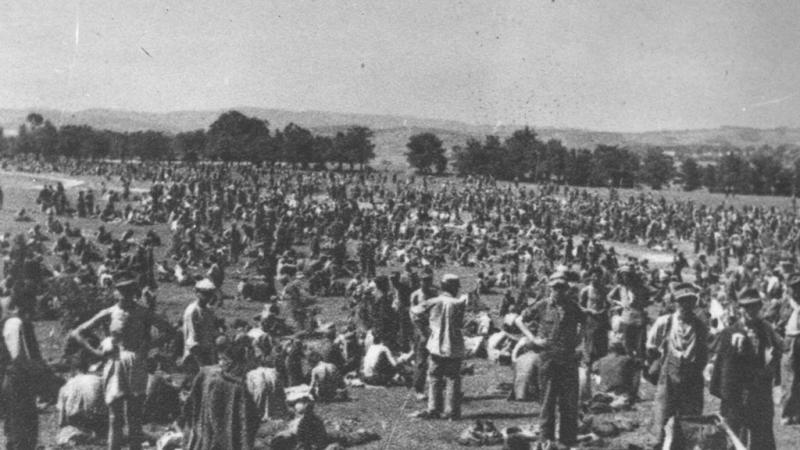



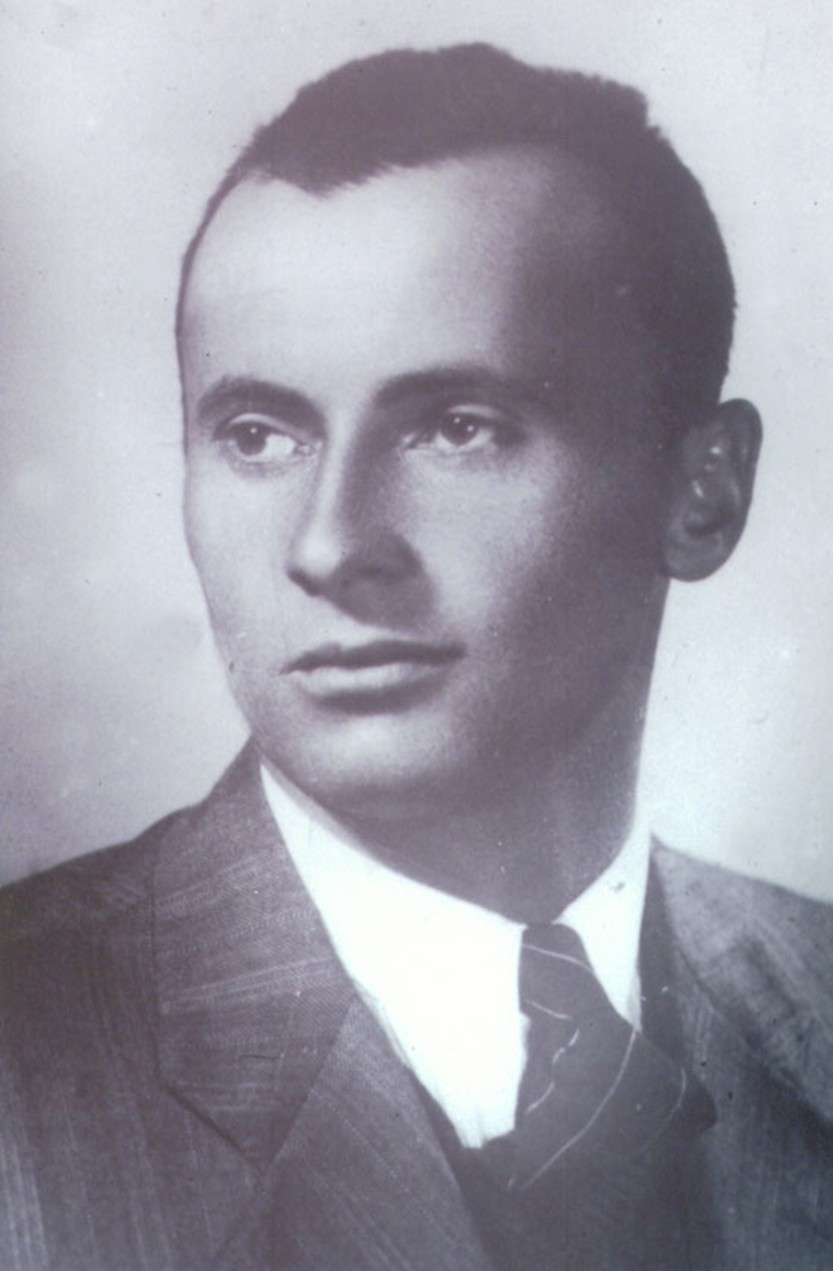


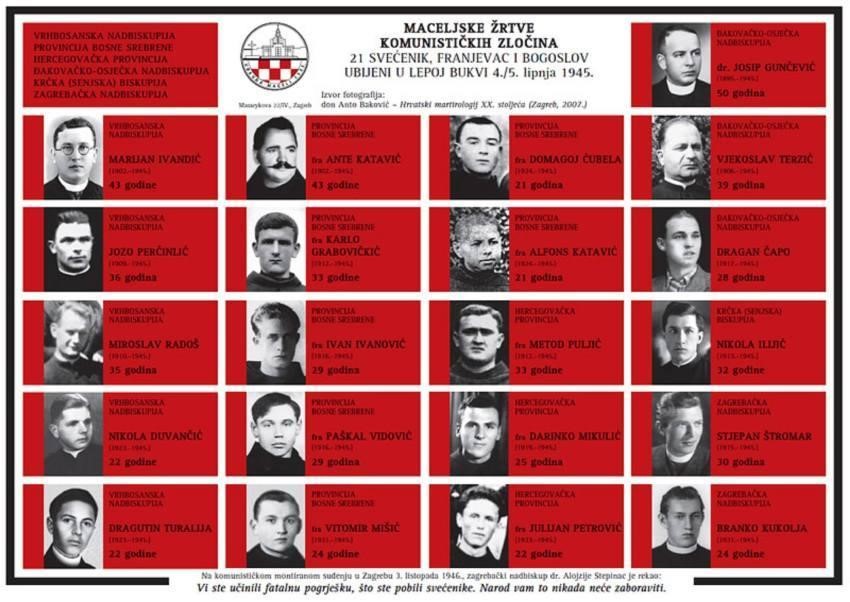
Stjepan Hršak, alias Štef, the notorious and cruel commander of the OZNA in Krapina, shot these Catholic priests and religious in the back of the head one night, after ordering them to kneel down…
Stjepan Hršak, OZNA commander
Mesić protected the murderer of 21 priests from Macelj
Stjepan Hršak, the head of the OZNA in Krapina, shot 21 priests in the head! When he was to be tried, the then President Stjepan Mesić visited him in his villa in Tuškanac. This was a clear signal to DORH (State’s Attorney Office of the Republic of Croatia) not to do anything.

In a normal democratic state under the rule of law, “comrade” Hršak Stjepan, “captain of the first class” of the JNA and OZNA, would be the most wanted war criminal in the world. However, in the Republic of Croatia, this suspected war criminal was under the protection of the authorities of the Republic of Croatia, especially under the protection of former President Mesić, who told the public that “anti-fascists should not be tried”. The criminalists from the war crimes department of the Zagreb criminal police did not have political approval to question the suspect Hršak at all, let alone to detain him and send him to pre-trial detention, which is unconstitutional because it turns out that not all citizens of the Republic of Croatia are equal before the constitution and law!
The accused is reasonably suspected of having personally killed the priests and Franciscans with his 7.65 mm pistol “Walter”, which he kept as a trophy in the villa on Tuškanac. Moreover, in June 1945, he personally led each and every prisoner column, from 50 to 100 prisoners in each, on foot to Macelj Mountain, cynically telling the dehydrated people on the way to the execution ground that “Pavelić’s spritzers are waiting for them up there”. In the Gradska Kavana café on Ban Josip Jelačić Square in Zagreb, he and his Partisan ‘comrades’ allegedly recalled on multiple occasions the ‘glorious heroic days’ in Macelj and Krapina when they were killing prisoners!
Today, the location of the cave on Macelj Mountain is known, thanks to a penitent, a former non-commissioned officer and guard of the OZNA “army” in Krapina, who was also involved in this great crime, Mladen Šafranko, who personally showed the location of each of the 130 pits to a victim of the Way of the Cross, Mr. Fran Živičnjak, some time in the 1990s. In 1998, after his mysterious death (he lived alone in an apartment and died in a bathtub from an electric shock, perhaps from an UDBA attack), Fran Živičnjak left to the Croatian people a booklet entitled:
“In Eternal Memory of the Croatian Soldiers, Priests and Franciscans and all the Croatian Martyrs Killed in May and June 1945 in Macelj Forest near Krapina and the Camps in Mirkovac near Sveti Križ Začretje and Oroslavlje”
“Let me hear joy and gladness;
let the bones that you have crushed rejoice.
Hide your face from my sins,
and blot out all my iniquities.”
(Ps 51 (50), 8-9)
During a visit to Bujica talk show on Z1 television, the President of the “Macelj 1945” Association, Dr. Stjepan Bačić, criticized the non-prosecution of post-war Communist crimes by Tito’s Partisans: “When I was a member of Parliament in 2004, I asked the then Prosecutor General Mladen Bajić why the crimes for which we have evidence and witnesses are not prosecuted.
At that time, the Ministry of Interior had recorded more than 900 locations with Croatian victims. Bajić only replied that everything was “in process.” Similarly, former MP Bruna Esih later asked new Prosecutor General Dinko Cvitan in the Parliamentary Committee on Human Rights why he excluded Communist crimes from his report… She received the answer, ‘everything is in process,’ and 12 years have passed…”
The diagonal of a crime
Alluding to the crime, Dr. Bačić continued: “Between 12 and 13 thousand Croats were killed in Macelj. In 1991, Cardinal Franjo Kuharić held the first Mass for the deceased there. The Mass was celebrated at the position of Lepa Bukva, the place where pit 4D is located. In it, 21 priests and another 60 Croatian army officers were found.
In 1992 it was decided to establish the Commission for the Investigation of Communist Crimes. The excavations in Macelj have begun. 23 pits have been excavated, from which 1,163 mortal remains have been extracted. There are more than 100 unexplored pits on Macelj Mountain. In 1992, the excavations were stopped…
Bačić says, “The murdered people were from all over Croatia, and we can conclude this precisely by looking at priests. The oldest among them, Josip Gunčević, came from the diocese of Đakovo, and most of the Franciscans came from the Franciscan province of Vrhbosna, with three friars from Široki Brijeg.”
One of the founders of the association “Macelj 1945”, a returnee from Canada and publicist Damir Borovčak, also spoke about the crime in Macelj Forest in Bujica: “I call it the diagonal of the crime. Three friars from Široki Brijeg ended up in Macelj. That is one diagonal… The other one goes from Zemun.
The murdered Josip Gunčević was the director of the Catholic gymnasium in Zemun, which belonged to Croatia at the time. They were murdered on the night of June 5, 1945. The youngest of them was 21 years old. They were taken from the Krapina monastery at 10 p.m., loaded onto trucks in the dark, and after that every trace of them was lost…”
Killed 21 priests and received a villa on Tuškanac as a reward
Borovčak named the murderer of 21 priests, “It was a great horror. Imagine a situation where a man kills 21 priests one after another with his gun! Kneel down, shot in the back of the head… Kneel down, shot in the back of the head… And 21 times so! According to the testimony of the survivor Fran Živičnjak, who was spared by the guard Mladen Šafrenko, a later penitent, and who showed us the pit where the murdered were lying, the priests were killed by Stjepan Hršak with his own hand! He was the head of the OZNA in Krapina.”
Borovčak continues, “Stjepan Hršak eventually ended up in Zagreb, where he worked for the OZNA in the 1950s and received a villa in Tuškanac Street 61 as a reward. He died of natural causes.”
Dr. Bačić tried to answer the question of why the criminal was never punished: “Members of our association, the Croatian Society of Victimology, and other movements, through the police and especially the DORH, tried to initiate an investigation and demanded that the criminal be prosecuted. However, the DORH never initiated an investigation and no charges were filed. Obviously, there was a lack of political will to investigate Communist crimes, let alone prosecute them…”
Mesić protected the murderer of the priests
Bačić recalls, “In 2009, a group of citizens protested in front of Stjepan Hršak’s house demanding an investigation, but everything was stopped when Stjepan Mesić, then President of the Republic, visited him a day later at his villa in Tuškanac. He asked that ‘deserving anti-fascists’ not be touched. And Hršak is probably ‘deserving’ because he killed 21 priests by his own hand…”
As a member of the Croatian Parliament 12 years ago, Dr. Stjepan Bačić called for the prosecution of Communist crimes. “The fact is that not a single crime committed by the Communists has been prosecuted. When I was a member of Parliament in 2004, I asked the then Prosecutor General Mladen Bajić why crimes for which we have evidence and witnesses are not prosecuted.
At that time, the MUP (Ministry of Interior) had recorded more than 900 locations with Croatian victims. Bajić only replied that everything was ‘in process’. Similarly, MP Bruna Esih asked Chief Prosecutor Dinko Cvitan in the Parliamentary Committee on Human Rights why he deleted the section on post-war Communist crimes from the working report.
She received a similar answer: ‘Everything is underway,’ ‘the investigation is ongoing,’ and 12 long years have passed… Witnesses die, criminals die, and prosecutors say everything is ‘in process.’ But now it is even worse, because Cvitan has removed even the verdicts related to Communist crimes from the 2015 report.”
Cvitan continued with Bajić’s politics
Dr. Bačić evaluated the work of the DORH when it comes to the Communist crimes of the post-war period, “There are criminals, there are commanders, and the result is still zero. As if no one killed 21 priests! Since the 1990s we have had a free and independent Croatia, and after so many years we raise our children with false information. Until 1990 we were not allowed to talk about all this, but why are we silent now?!”
Damir Borovčak continued after Bačić, “Mladen Bajić had said to Dr. Bačić 12 years ago the same thing that Dinko Cvitan later would say to the MP Esih, only now they have gone one step further and removed the chapter on Communist crimes from the work report!
One gets the impression that they do not really want the commanders to be punished. This can also be concluded from what Mesić did. He publicly asked for the protection of the murderer of 21 priests! Of course, the DORH did nothing since the President publicly supported the murderer! It was an obvious pressure on the DORH, and since then they have done nothing.
When Josip Boljkovac was arrested, everyone mockingly said that an old man had been arrested, but it is interesting that the same was not said about Andrija Artuković, Dinko Šakić, Stjepan Hršak or Josip Manolić…. When the Communists were supposed to be put to trial, then it was ridiculous and they were deemed too old for that, but if Croats were the ones to be put on trial – then it was a different story.
The rules are different, depending on the structure. Penitent Mladen Šafranko listed no less than 15 names of executioners from Macelj, out of a total of about 60 who were known. All 15 murderers have died to date and have not been prosecuted. So the institutions took no steps, in order to let them die in peace. They protected them.
Hebrang: DORH consciously covers up Communist crimes
Dr. Andrija Hebrang, former Chairman of the Board of the Office for Investigation of Communist Crimes, telephoned the show “Bujica”: “It is unacceptable that the State’s Attorney tells a member of Parliament that she can look information up on the Internet! The Parliament was not in the business of discussing websites, but the report of the State’s Attorney! It is inadmissible to withhold such material from the members of parliament. Whether Cvitan includes the post-war Communist crimes in the report or not, in either case the result is the same… Every year we hear the same thing: ‘The investigation is underway.’
It is a fact, this is being deliberately covered up! The State’s Attorney not only does not prosecute the Communist crimes, but also does not prosecute the Serbian crimes from the Homeland War. For example, for the shelling of 14 Croatian hospitals, not a single investigation was opened and not a single indictment was filed. Thus, everything that happened in 1991 will be forgotten just like what happened in 1945.”
Borovčak linked the crime in Macelj to the Yugoslav Communist leadership and dictator Tito: “After the war, the Macelj area was declared a restricted area and Tito’s hunting ground was located there. According to our information, Tito came there at least three times to hunt wild boars. Stevo Krajačić, who was the link between Tito and Stjepan Hršak, the murderer of the priests, also hunted there. There are photos proving that as well. And so we come to the connection Hršak – Krajačić – Tito. If we add the documents to that, it is absolutely clear that the crime against 12,000 Croats in Macelj was ordered by the party and state leadership under Tito.”
Dr. Bačić concluded with lustration. “If lustration had taken place in Croatia and the people who were actively involved in the criminal Communist system had been removed from public life, today we would be talking casually about all these issues. The criminals would be prosecuted and the victims would be buried with dignity. But this has not happened. People associated with the former regime continue to work in the institutions, and that is why there are no results. Without the truth, we will never be a free people.”
Editorial/crimesofcommunism.net